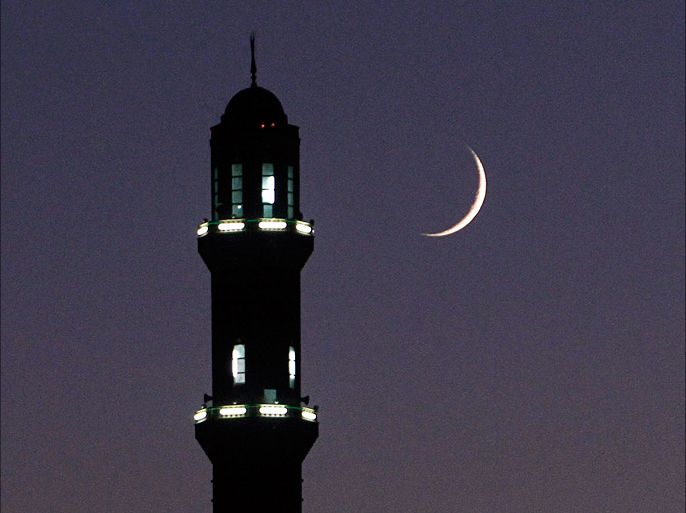
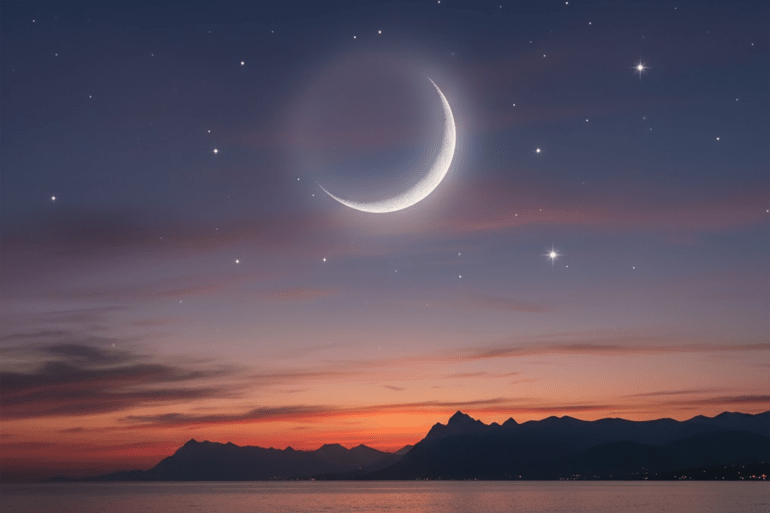
Searching for the crescent moon on the evening of the 29th day of the lunar month might seem straightforward; since childhood, we have heard from specialists that the next month begins with the sighting of the crescent. But behind this simplicity lies a question worth pausing over: why do we specifically anticipate the crescent as the sign of the beginning, and not any other phase of the moon, such as the first quarter?
To answer this question, we need to learn some astronomy about the moon’s movement in the sky, which gives us an understanding of the moon’s cycle around the Earth, and then we can understand why months begin and end with crescents.
The Moon’s Cycle Above
Let’s start with a simple experiment. Place a high-power lamp in front of you on a table. Then, hold a small plastic ball and extend your arms forward, and slowly spin around in front of the lamp.
You will notice that the lamp’s light reflects off that ball in your hands, but this reflection will give off light that changes bit by bit as you spin. For example, when you are facing the lamp directly, you won’t be able to see the ball clearly because the intensity of the lamp’s light blinds you. In this case, the ball is “completely dark.”
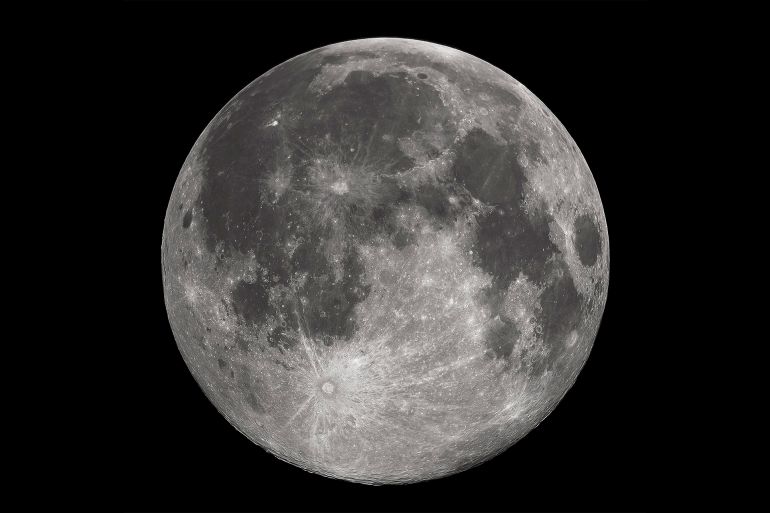
When you start to spin, you will notice the lamp’s light increasing on the ball, exactly like the phases of the moon that begin with the crescent, then increase a bit until it fills to the first quarter, then the full moon. The full moon occurs when your back is to the lamp and the ball is in front of you, so you see it fully illuminated from your perspective (just imagine you are small enough for the light to pass through to the ball). After that, the moon’s illumination decreases until it returns to zero again.
This means that the phases of the moon are essentially just our perspective from Earth towards the moon; the moon itself is always illuminated by 50 percent by the sun, as shown in the attached diagram.
Now let’s contemplate that specific cycle of the moon but from our perspective on Earth. The new lunar month is born when the moon is standing exactly next to the sun (“new moon”), so we cannot see it because the sun’s light blinds us to it. Then, on the next day, the moon has moved a bit in its orbit away from the sun. In that case, we will see the sun set and then the moon set after it.
For us, the moon’s setting is delayed after the sun by about 50 minutes each day. This is not magic, but simply the natural consequence of the moon’s movement around the Earth, from our perspective on Earth.
Let’s give a simple example: On one day, if the sun sets at 6:00 PM and the moon sets after it at 6:50 PM, the next day we add a dose and the moon sets at 7:40 PM. Then an additional 50 minutes for the next day, so the sun sets around 6:00 PM and the moon at 8:30 PM, and so we continue adding 50 minutes each day, and the moon continues to be present in the sky for a longer period and at a greater distance from the sun.
This means that on the day of the full moon, after about 14 days, a number of minutes will have passed that allows the moon to rise (from the east) at the moment the sun sets on the other side. The moon continues to diverge in its setting from the sun day after day, until it reaches it from the other side, they meet again, and another month begins.
The Moon’s Change and the Meaning of “
crescent moon
The Crescent Moon is a scenic desert oasis located near Dunhuang, China, famous for its natural spring that has formed a lake in the shape of a crescent. Historically, it was a vital stop on the ancient Silk Road, providing essential water for travelers and caravans for over 2,000 years. Today, it is a major tourist attraction and is protected alongside the nearby Mingsha Sand Dunes.
Jordanian mosque
The Jordanian mosque is a general term for Islamic places of worship in Jordan, with the most famous being the King Abdullah I Mosque in Amman. Completed in 1989, this iconic blue-domed mosque was built as a memorial to Jordan’s founder and reflects modern Islamic architectural styles. Mosques across the country serve as central community hubs, with many historic sites like those in Petra showcasing the deep Islamic heritage of the region.
Amman
Amman is the capital and largest city of Jordan, with a history dating back to the 13th century BC when it was known as Rabbath Ammon. The city is built on seven hills and features significant Roman ruins, most notably the well-preserved Roman Theatre from the 2nd century AD. Modern Amman serves as the country’s economic and political center, blending ancient history with contemporary urban life.
Jordan
Jordan is a Middle Eastern country with a rich historical legacy, most famously as the location of Petra, the ancient Nabatean city carved into rose-red cliffs. Its history spans numerous civilizations, including the Roman, Byzantine, and Islamic empires, with significant sites like the Roman ruins at Jerash. The country also holds religious significance, containing biblical locations such as the believed site of Jesus’s baptism along the Jordan River.
Ramadan
Ramadan is the ninth month of the Islamic lunar calendar, observed by Muslims worldwide as a month of fasting, prayer, reflection, and community. Its history is rooted in the Islamic tradition that it was during this month that the Quran was first revealed to the Prophet Muhammad.
moon
The Moon is Earth’s only natural satellite, believed to have formed around 4.5 billion years ago from debris after a massive collision between Earth and a smaller planet. Culturally, it has been a central object in mythology, timekeeping, and human exploration, most notably with the first crewed landing by Apollo 11 in 1969.
Earth
Earth is the third planet from the Sun and the only known astronomical object to harbor life, with a geological history spanning over 4.5 billion years. Its surface features diverse ecosystems and has been the cradle for the development of all known human cultures and civilizations.
sun
The sun is not a specific place or cultural site, but a star at the center of our solar system. It has been central to human cultures throughout history, often worshipped as a deity in ancient civilizations like those of Egypt and Mesoamerica. Its predictable cycles have fundamentally shaped calendars, agriculture, and mythologies worldwide.
Mercury
Mercury is a chemical element with the symbol Hg and atomic number 80, historically known as quicksilver. It has been used since ancient times in applications such as gilding and thermometers, and it is the only metallic element that is liquid at standard room temperature. Its name originates from the Roman god Mercury, known for his speed and mobility.