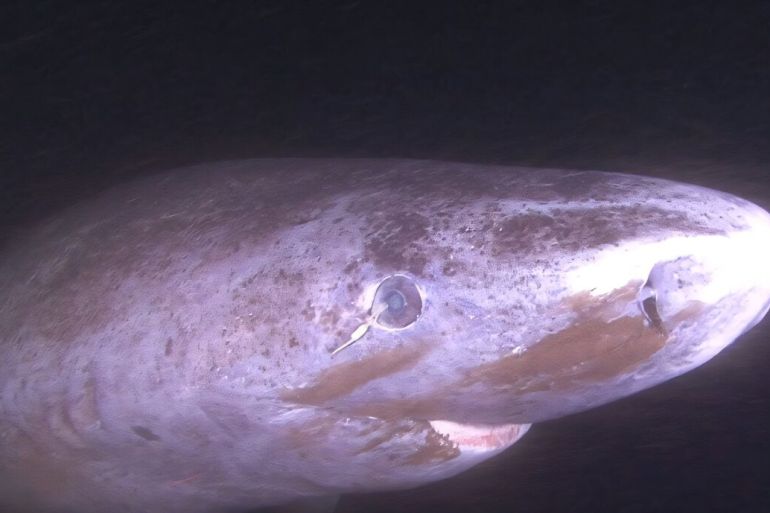
The incident of catching a “great white shark” off the Spanish coast in the spring of 2023 was not just a passing maritime event. The shark caught in fishermen’s nets was a “juvenile,” not an adult.
This observation seems minor on the surface but holds significant scientific meaning. Sighting juveniles could provide a clue to understanding whether this famous predator still maintains an actual presence in the western Mediterranean, or if its appearances are merely rare, sporadic visits.
The incident prompted Spanish researchers to revisit a long record of historical reports and scattered data accumulated over more than a century and a half.

Rare Appearance
According to research published in the journal “Acta Ichthyologica et Piscatoria,” the rarity of sightings does not necessarily mean rarity of presence. It may simply reflect the difficulty of tracking a wide-ranging migratory species like the great white shark, which is only seen when it intersects with human activities.
Recent research reviews indicate that the great white shark in the Mediterranean is sometimes described as part of a “ghost population”—present in the background but rarely appearing, with its existence revealed through scattered, sparse signals.
In the Mediterranean specifically, the situation is further complicated by a long history of bycatch, changes in prey abundance, and degradation of marine habitats. This makes any documented record a scientific event worthy of careful study, rather than being consumed merely as sensational news.
In many species, the presence of juveniles is linked to areas closer to “nurseries” or relatively safer environments. Therefore, the presence of a small individual opens up the possibility of conditions that allow for repeated appearances of juveniles. However, this is not the only possibility; it might have come from a distant area and then entered Spanish waters in passing.
The matter becomes more complex because large sharks do not leave an easy trace on the sea surface. Therefore, researchers sometimes resort to indirect clues, such as predation marks on sea turtles or prey remains bearing distinctive bite marks.
Such signals are not conclusive evidence on their own, but—when repeated and linked to a specific time and place—they can help paint an approximate picture of potential transit routes and their relationship to seasonal prey abundance.

Ecological Role
More importantly, this story is not just about tracking a species feared in the popular imagination; it is a window into a sensitive ecological role. The great white shark is classified as an apex predator, meaning it can influence the balance of food webs, the behavior and distribution of prey, and the dynamics of the ecosystem as a whole.
When apex predators disappear or decline severely, indirect effects can appear at multiple levels of the food chain.
In summary, the data does not say that great white sharks have returned to the Spanish coasts in a direct sense, nor that the Mediterranean is spontaneously regaining its balance. But it does indicate signs of a rare and scattered presence, and that every documented sighting—especially of juveniles—deserves to be transformed from a fishing tale into scientific research.