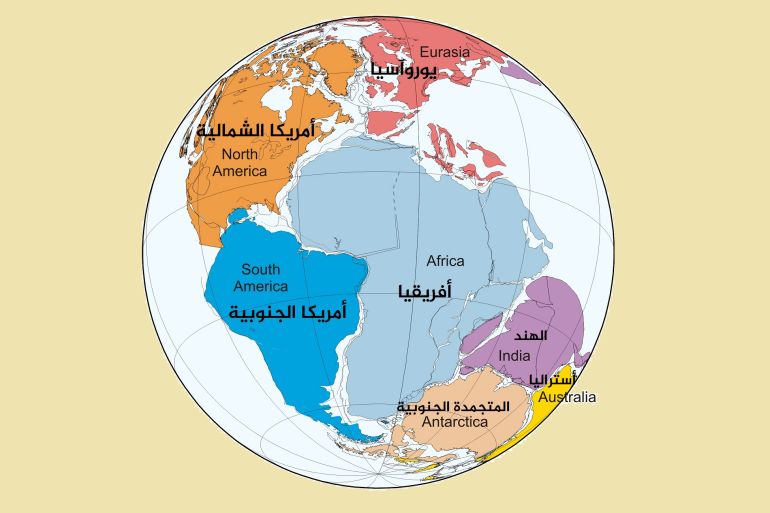
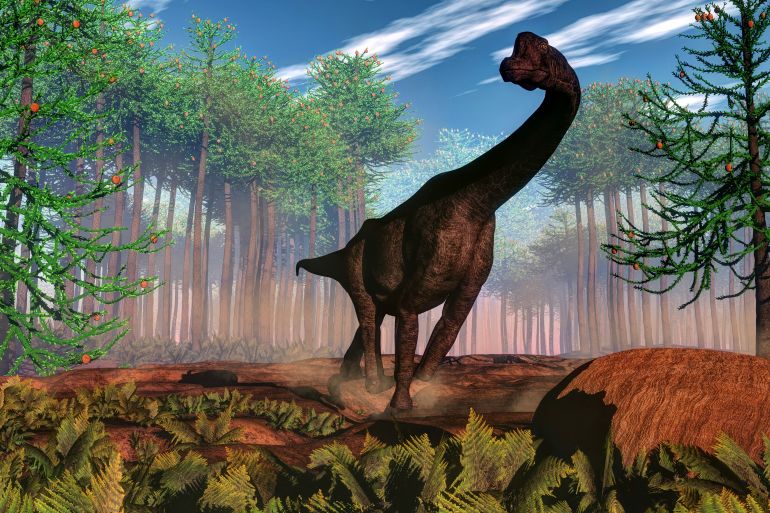
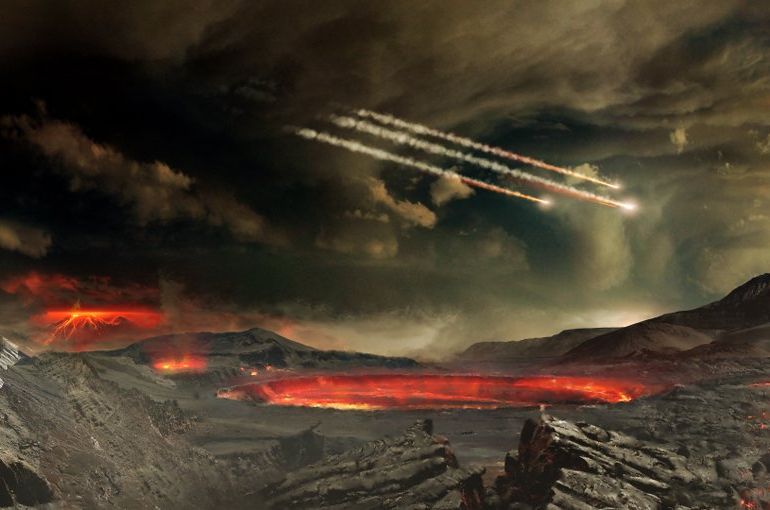
Around 200 million years ago, Earth’s continents were united in a single landmass known as “Pangea.” After its breakup, the world we know today, with its separate continents, was formed.
However, a study published in “Geological Magazine” suggests that the tectonic plate forces that separated the continents could bring them back together again into a new supercontinent within roughly 200 million years.
The novelty of this scientific proposition is not just the inevitability of the next continent’s formation, but the multiple possible scenarios, each painting a radically different and potentially devastating climatic future for human life.
Oceans Closing and Others Expanding
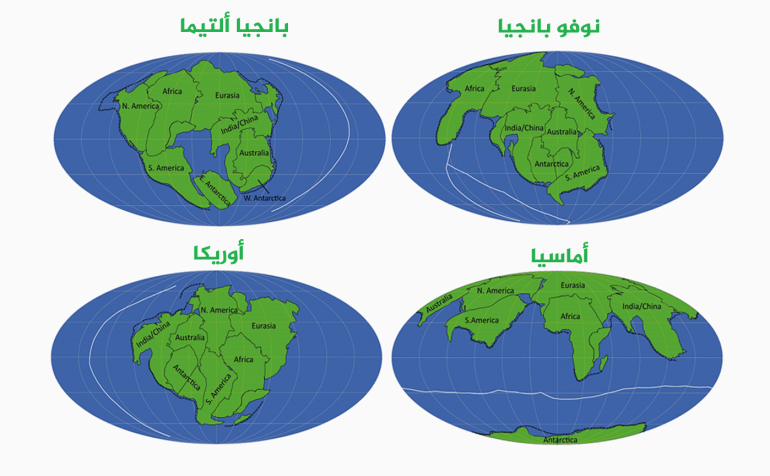
Researchers see four main models for the aggregation of continents. The first and most prominent assumes the continued expansion of the Atlantic Ocean against the shrinking of the Pacific Ocean, which is surrounded by active subduction zones known as the “Ring of Fire,” where about 80% of major earthquakes occur.
In this scenario, the Americas drift further apart before later merging with a landmass containing Africa, Europe, and Asia, giving rise to a continent scientists have named “Novopangea.”
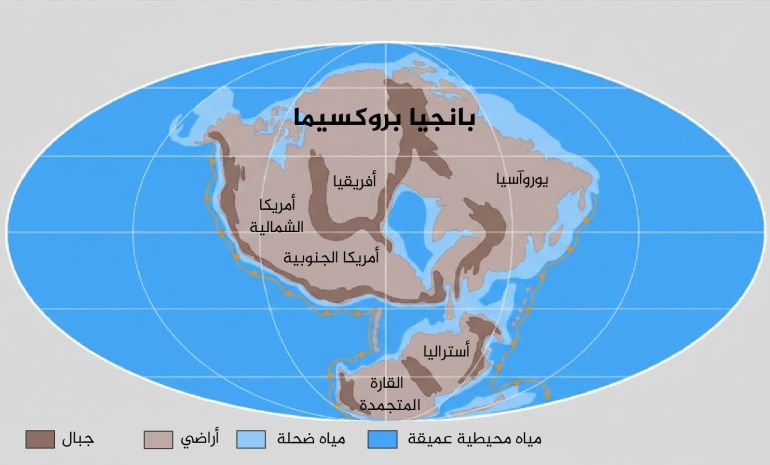
The second scenario is called “Pangea Proxima,” in which the Atlantic and Indian Oceans are expected to continue expanding before new subduction zones emerge, bringing the continents back together in a ring shape encircling a small inner ocean.
As for the “Aurica hypothesis,” the third scenario, it suggests the closure of both the Pacific and Atlantic Oceans, while the Indian Ocean remains open, leading to the continents gathering along the equator in a relatively warm and dry continent.
In contrast, the “Amasia model,” the fourth scenario, proposes the closure of the Arctic Ocean, with the Atlantic and Pacific remaining open. Most continents would drift north and gather near the North Pole, while Antarctica remains isolated in the midst of a vast ocean.
Global Freeze or Harsh Warming
In a three-dimensional climate study published in the journal “Geochemistry, Geophysics, Geosystems,” a simulation was conducted for the Aurica and Amasia scenarios.
The results were striking: In the case of Amasia, the “ocean conveyor belt” that transports heat from the equator to the poles could be disrupted, leading to permanent cooling and the expansion of ice sheets. This cooling would increase Earth’s surface reflectivity, plunging the planet into a worsening cooling cycle that could wipe out most forms of terrestrial life.
As for the Aurica scenario, models predict an average temperature rise of about 3 degrees Celsius compared to today, with a warmer and drier climate, extended coastlines similar to present-day Brazil, and extensive coral reefs and dune systems.
The “Pangea Proxima” scenario that could bring continents back together in a ring shape
The intriguing fact is that both scenarios—despite their differences—could increase the likelihood of mass extinction. The merging of continents would lead to intense competition among species for resources, while ice ages or severe heat waves could erase most terrestrial creatures, with marine life remaining more resilient.
Although these predictions speak of events hundreds of millions of years in the future, scientists warn that intelligence alone does not guarantee human survival. Technology grants the ability to survive, but it also grants the capacity for self-destruction.
If humanity wishes to survive until the time of the next supercontinent, researchers indicate it must learn to live in long-term harmony with its ecosystem.
Pangea
Pangea refers to the supercontinent that existed during the late Paleozoic and early Mesozoic eras, approximately 335 to 175 million years ago. It formed through the gradual movement of tectonic plates and later began to break apart due to continental drift, eventually separating into the landmasses that define Earth’s modern geography.
University of Texas
The University of Texas at Austin is a public research university founded in 1883, though its origins trace back to the 1839 Texas Constitution which set aside land for a future university. Its iconic main building, the UT Tower, was completed in 1937 and has become a central symbol of the institution.
Geological Magazine
The Geological Magazine is a long-running peer-reviewed scientific journal established in 1864, dedicated to publishing research across all aspects of the geosciences. It has played a significant role in disseminating geological discoveries and debates for over 150 years, contributing to the development of the field as a modern science.
Atlantic Ocean
The Atlantic Ocean is Earth’s second-largest ocean, formed approximately 150 million years ago by the separation of the supercontinent Pangaea. It has served as a critical corridor for exploration, trade, and cultural exchange between the Americas, Europe, and Africa throughout human history.
Pacific Ocean
The Pacific Ocean is the world’s largest and deepest ocean, covering more than 60 million square miles. It was named by the explorer Ferdinand Magellan in 1520 for its seemingly calm waters, though it has a long history of human migration, trade, and cultural exchange across its many islands and surrounding continents.
Ring of Fire
The Ring of Fire is a major area in the basin of the Pacific Ocean where a large number of earthquakes and volcanic eruptions occur. It is a direct result of plate tectonics, specifically the movement and collisions of lithospheric plates, and its volcanic and seismic activity has shaped the geology and human history of the surrounding regions for millennia.
Americas
The term “Americas” refers to the continents of North and South America, which were home to advanced indigenous civilizations like the Maya and Inca before European colonization began in the late 15th century. Following widespread exploration and settlement by European powers, the continents later saw waves of independence movements that established the modern nations existing today.
Africa
Africa is the world’s second-largest continent, widely recognized as the birthplace of humanity, with fossil evidence tracing the origins of Homo sapiens back hundreds of thousands of years. It is home to countless diverse cultures and historic sites, from the ancient civilizations of Egypt and Mali to the natural wonders of the Serengeti and the Sahara Desert.
Europe
Europe is a continent with a rich and complex history, shaped by ancient civilizations like Greece and Rome, the Middle Ages, the Renaissance, and transformative events such as the Industrial Revolution and two World Wars. It is home to a vast array of cultural sites, from prehistoric cave paintings to medieval castles and modern architectural marvels, reflecting its diverse peoples and historical developments.
Asia
Asia is the world’s largest and most populous continent, home to ancient civilizations like those in Mesopotamia, the Indus Valley, and China. Its history spans millennia, featuring the rise and fall of vast empires, the spread of major world religions, and profound technological and cultural innovations that have shaped global history.
Novopangea
Novopangea is a fictional supercontinent featured in various speculative future world maps and science fiction works, projecting a potential future geological configuration of Earth’s landmasses. It is envisioned as the next supercontinent that could form hundreds of millions of years from now through the ongoing process of plate tectonics, following the cycle that previously created Pangea.
Hannah S. Davies
Hannah S. Davies was a prominent American philanthropist and civic leader in St. Louis, Missouri, in the late 19th and early 20th centuries. Her legacy is primarily honored through the **Hannah S. Davies Walking Trail** in Tower Grove Park, a path dedicated to her memory and her family’s contributions to the park’s development.
Lisbon University
The University of Lisbon was originally founded in 1288, making it one of the oldest universities in the world, though it was later re-established in its modern form in 1911. It is Portugal’s largest university and a major center for academic research and learning, with its historic campus featuring notable architectural styles like Pombaline and Modernist.
Portugal
Portugal is a country in southwestern Europe on the Iberian Peninsula, with a rich history as a global maritime power during the Age of Discoveries in the 15th and 16th centuries. Its cultural heritage is reflected in landmarks like the Jerónimos Monastery in Lisbon and the historic centre of Porto, both UNESCO World Heritage Sites.
Pangea Proxima
Pangea Proxima is a hypothetical future supercontinent, predicted by some geological models to form in approximately 250 million years through the ongoing movement of Earth’s tectonic plates. It represents a projected next assembly of the world’s continents, similar to the ancient supercontinent Pangea from which it takes its name.
Indian Ocean
The Indian Ocean is the world’s third-largest ocean, bounded by Africa, Asia, Australia, and the Southern Ocean. It has been a critical region for trade and cultural exchange for millennia, with its history deeply shaped by monsoon winds that powered ancient routes between civilizations in East Africa, the Middle East, South Asia, and Southeast Asia.
Aurica
Aurica is a proposed luxury retail and cultural complex planned for Las Vegas, Nevada, designed to be a high-end destination for shopping, art, and entertainment. Its concept, announced in the late 2010s, draws inspiration from global luxury districts and aims to integrate curated cultural experiences with retail. The project’s history is still being written as it moves through development and seeks to establish itself as a new landmark.
Amasia
Amasia is a hypothetical future supercontinent predicted by some geological models to form in approximately 200–300 million years, as the Pacific Ocean closes and the continents merge around the North Pole. This potential landmass, named by combining “America” and “Asia,” follows the theorized supercontinent cycle, succeeding the ancient supercontinent of Pangaea.
Arctic Ocean
The Arctic Ocean is the smallest and shallowest of the world’s five oceans, centered on the North Pole and largely covered by sea ice. Historically, its edges have been inhabited for millennia by Indigenous peoples, while its exploration by outsiders intensified during the quest for the Northwest Passage and the North Pole in the 19th and 20th centuries.
North Pole
The North Pole is the northernmost point on Earth, located in the middle of the Arctic Ocean and covered by shifting sea ice. Unlike the South Pole, it has no landmass and no permanent human settlement or indigenous history, though it has been a target for exploration since the 19th century, with Robert Peary’s disputed 1909 expedition being among the most famous claims of reaching it.
Antarctica
Antarctica is Earth’s southernmost continent, characterized by its extreme cold, vast ice sheets, and unique ecosystems. Historically, it has no native human population, but its exploration began in the early 20th century, and it is now governed by an international treaty system dedicated to peace and scientific research.
Geochemistry, Geophysics, Geosystems
“Geochemistry, Geophysics, Geosystems” (G-Cubed) is a peer-reviewed scientific journal, first published in 2000, that focuses on interdisciplinary research in Earth and planetary processes. It publishes original studies that integrate geochemistry, geophysics, geology, and related fields to understand the structure, evolution, and dynamics of the Earth and other celestial bodies.
Brazil
Brazil is the largest country in South America, known for its vast Amazon rainforest and vibrant cultural exports like samba and football. Its modern history began with Portuguese colonization in 1500, leading to independence as an empire in 1822 and the establishment of a republic in 1889. The nation is a fusion of Indigenous, European, and African influences, reflected in its diverse society, music, and annual Carnival celebrations.
Encyclopædia Britannica, Inc.
The Encyclopædia Britannica, Inc. is the publisher of the Encyclopædia Britannica, one of the world’s oldest and most comprehensive general knowledge encyclopedias. It was first published in Edinburgh, Scotland, in 1768 and has evolved from a multi-volume print reference work to a major digital educational resource.