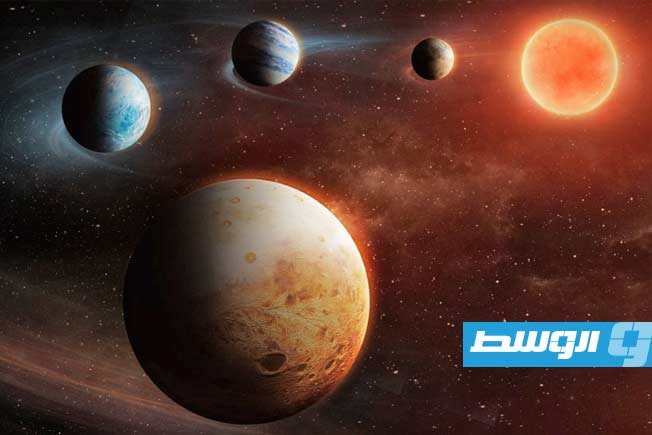
An international team of astronomers has observed an unusual planetary system orbiting a star known as LHS 1903, located in the thick disk of the Milky Way galaxy. It is characterized by an arrangement of its planets that contradicts prevailing scientific models of planet formation.
Analyses based on data collected from several ground-based and space telescopes, including the European telescope specialized for observing exoplanets (Cheops), revealed the existence of four planets orbiting a red dwarf star that is colder and less luminous than the sun.
According to the results, the system consists of a rocky planet close to the star, followed by two gas planets, and then a fourth rocky planet located in a more distant orbit.
Exceptional arrangement defies established theories
This arrangement is considered exceptional, as established theories indicate that rocky planets typically form in regions close to the star where heat and intense radiation dissipate gases, while gas planets form in colder, more distant regions.
However, the presence of a rocky planet at the outskirts of this system raises questions about its formation mechanism.
– Discovery of a ‘Cold’ Planet with Characteristics Largely Similar to Earth
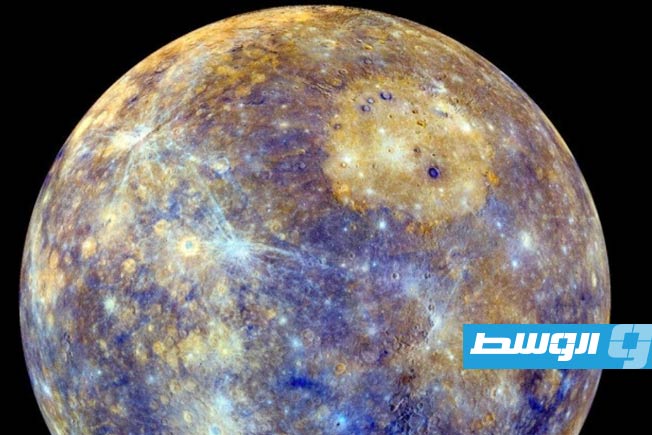
– Mercury is Not Dead: Study Reveals Recent Geological Activity on the Small Planet’s Surface
– ‘James Webb’ Telescope Reveals Secrets of the ‘Helix Nebula’ and the Cosmic Stage of Demise
Researchers suggest that the planets in this system may not have formed simultaneously within a gas-rich protoplanetary disk, as the traditional theory assumes, but rather may have formed sequentially.
The proposed hypothesis indicates that the outermost planet may have emerged at a later stage, after the disk surrounding the star had depleted most of its gaseous components, preventing the formation of a dense atmosphere around it.
This discovery represents new evidence of the diversity of formation mechanisms for planetary systems outside our solar system and reinforces the need to re-evaluate existing theoretical models in light of the increasing number of planetary systems that do not align with what is known about our solar system.