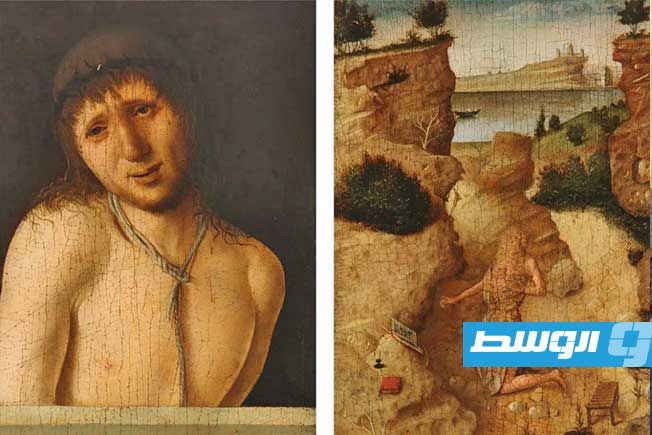
The Italian Ministry of Culture has successfully acquired a rare painting by the Italian artist Antonello da Messina for $14.9 million, thereby withdrawing it from the public auction of old master paintings at Sotheby’s in New York and ensuring its return to its homeland.
This painting, titled “Ecce Homo and Saint Jerome in the Desert,” is a unique piece, as it was the only remaining work in private hands among approximately 40 known works by this Renaissance master.
Dating from the mid-15th century, the painting is notable for being painted on both sides. One side depicts Christ with a movingly human expression, wearing the crown of thorns, while the other side shows Saint Jerome kneeling in the desert.
“Humanity in its deepest form”
It was noted that the work embodies Antonello’s exceptional ability to capture “humanity in its deepest form,” an artistic level achieved only by the greatest masters. The painting’s original owner reportedly treated this small panel as a precious devotional object.
– A Klimt painting becomes the second most expensive artwork ever sold at auction
– A rare Botticelli painting to be offered at a New York auction
The painting passed through centuries among private collections in Spain and Italy before arriving in New York this year, where it was offered with an estimate of $10 to $15 million.
The art and cultural community views the deal as a major cultural victory, returning an essential piece of Italian art history to public ownership and protecting it from disappearing again into the corridors of private collections.
Italian Ministry of Culture
The Italian Ministry of Culture, formally the Ministero della Cultura (MiC), is the government department responsible for preserving, managing, and promoting Italy’s vast artistic, archaeological, and landscape heritage. It was established in 1975 as the Ministero per i Beni Culturali e Ambientali, reflecting a growing national commitment to safeguarding cultural and environmental assets following significant post-war development.
Antonello da Messina
Antonello da Messina was a prominent Italian Renaissance painter from Sicily, active in the 15th century, who is celebrated for introducing Flemish oil painting techniques and detailed portraiture to Italian art. His most famous work, the “Virgin Annunciate,” exemplifies his mastery of light and serene human expression. His synthesis of Northern European and Italian styles significantly influenced the development of Venetian painting.
Sotheby’s
Sotheby’s is a British-founded multinational corporation headquartered in New York City, established in London in 1744 as an auction house for rare books. It has since evolved into one of the world’s largest and most prominent brokers of fine art, jewelry, and collectibles, playing a central role in the history of the art market.
New York
New York City, originally settled by the Dutch as New Amsterdam in the early 17th century, was later taken by the English and renamed. It grew into a major global port and financial center, becoming a primary gateway for immigrants entering the United States through Ellis Island in the late 19th and early 20th centuries. Today, it is one of the world’s most influential cities, known for landmarks like the Statue of Liberty, Times Square, and its diverse cultural and economic impact.
Ecce Homo and Saint Jerome in the Desert
“Ecce Homo and Saint Jerome in the Desert” refers to two distinct subjects in Christian art. “Ecce Homo” (Latin for “Behold the Man”) is a common artistic theme depicting Jesus presented to the crowd by Pontius Pilate before the Crucifixion. “Saint Jerome in the Desert” is another frequent subject showing the 4th-century scholar Saint Jerome during his penitential retreat in the Syrian desert, often depicted with a lion and a skull.
Spain
Spain is a country in southwestern Europe with a rich and diverse cultural heritage, shaped by influences from Celtic, Roman, Visigothic, and most notably, nearly 800 years of Moorish rule. Its history includes the unification under Catholic monarchs in the late 15th century, a vast global empire, and the 20th-century Spanish Civil War followed by a transition to democracy. Today, it is renowned for its historic cities, distinctive regions, and contributions to art, architecture, and cuisine.
Italy
Italy is a country in Southern Europe with a rich cultural history that dates back to the Roman Empire, which was one of the largest and most influential civilizations of antiquity. It later became the birthplace of the Renaissance, a period of immense artistic and intellectual achievement centered in cities like Florence and Rome. Today, Italy is renowned for its profound contributions to art, architecture, cuisine, and fashion, and it hosts numerous UNESCO World Heritage Sites.