The car’s interior rearview mirror is one of the most important safety elements in any vehicle. It plays a pivotal role in monitoring traffic behind the car, assisting with lane changes, reversing, and driving in heavy traffic. Despite its small size, a detached rearview mirror can escalate from a minor nuisance to a real danger threatening the safety of the driver, passengers, and everyone on the road.
We will review the reasons why a car’s interior mirror falls off, the tools needed to repair it, and the correct step-by-step repair procedure.
Why does the car’s interior mirror fall off?
Understanding the real reason behind the rearview mirror detaching helps you fix the problem at its root, not just temporarily reattach it. Here are the most common causes:
Deterioration of the adhesive over time
– The car’s interior mirror relies on a special adhesive to bond the mounting base to the windshield. Over time, this adhesive is exposed to several factors such as:
– High heat.
– Constant vibrations while driving.
All of this gradually weakens the bond until the mirror suddenly falls off.
Incorrect installation
– In many cases, the problem stems from a previous incorrect installation, whether when replacing the mirror or after changing the windshield. Not cleaning the surface properly or using an adhesive not intended for automotive use leads to adhesion failure quickly.
Excessive exposure to heat
– Leaving the car for long periods under direct sunlight, especially in summer, causes the glass and adhesive materials to expand and contract. This weakens the mounting strength and increases the likelihood of the mirror falling.
Excessive weight hanging on the mirror:
– Hanging heavy air fresheners, accessories, or dash cams on the interior mirror increases pressure on the mounting point. This is a common cause for it falling off, especially on rough roads.
How to effectively and safely repair a car’s interior mirror
Tools and materials needed to repair a car’s interior mirror:
– Automotive-grade mirror adhesive or a reinstallation kit.
– Razor blade or plastic scraper.
– Isopropyl alcohol or glass cleaner.
– Clean microfiber cloth.
– Masking tape.
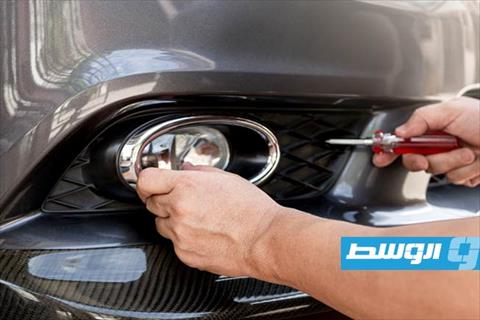
– Screwdriver or Allen key (in case of mounting screws).
Step One: Choose the right location.
– Park the car on a level surface and in a shaded area if possible. The windshield should be cool to the touch, as high heat reduces the adhesive’s effectiveness.
Step Two: Remove old adhesive residue.
– Use a razor blade or plastic scraper to remove any old adhesive residue from the windshield and the mirror’s metal mounting base. Be careful not to scratch the glass.
Step Three: Clean the surface thoroughly.
– Wipe the glass and mounting base with isopropyl alcohol to remove any grease, dust, or moisture. This step is essential to ensure a strong, long-lasting bond.
Step Four: Precisely determine the mirror’s position.
– From the outside, place a small piece of masking tape on the glass to mark the mirror’s original position. This helps reinstall it correctly without misalignment.
Step Five: Apply the adhesive.
– Follow the instructions on the car mirror adhesive package precisely. In some cases, you need to secure the base with masking tape for a few minutes to ensure it stays in place.
Step Six: Wait for the adhesive to dry.
– Most adhesives need about 30 minutes for initial setting and may require up to 24 hours for full curing. Do not attach the mirror before the specified time is complete.
Step Seven: Reinstall and adjust the mirror.
– After ensuring the adhesive is completely dry, attach the mirror to the mounting base, tighten any screws if present, then adjust the mirror’s angle for the best rear view.
car
The car, as a personal transportation vehicle, was invented in the late 19th century, with Karl Benz’s 1885 Motorwagen often credited as the first true automobile. Its mass production, pioneered by Henry Ford’s Model T in 1908, revolutionized society by enabling unprecedented personal mobility and reshaping global infrastructure and economies.
windshield
“Windshield” is not a specific place or cultural site; it refers to the front window of a vehicle. Its history is tied to the development of automobiles, evolving from early open cars to the introduction of laminated safety glass in the 1920s to reduce injury from shattering.
mirror
A mirror is a smooth surface that reflects light, most commonly made of glass coated with a reflective metal layer. Its history dates back to ancient times, with early examples crafted from polished obsidian, bronze, or silver. The modern glass mirror, backed with a tin-mercury amalgam, was developed in the 16th century, later evolving to use silvered glass in the 19th century.
rearview mirror
The rearview mirror is an automotive safety device invented in 1906 by Ray Harroun, who first used it in the Indianapolis 500 race of 1911. It allows drivers to monitor traffic behind them without turning their heads, becoming a standard and legally required feature in vehicles worldwide.
air fresheners
Air fresheners are consumer products designed to mask or eliminate unwanted odors in indoor spaces, with their modern history beginning in the 1940s with the invention of aerosol-based sprays. They have since evolved into a wide variety of forms, including gels, plug-ins, and solids, becoming a common feature in homes, cars, and public areas worldwide.
dash cams
Dash cams are dashboard-mounted video cameras that continuously record the view through a vehicle’s windshield. They originated in Russia in the early 2000s, largely driven by a need for evidence due to widespread insurance fraud and unpredictable police encounters. Their use has since expanded globally for security, documenting accidents, and capturing travel footage.
razor blade
A razor blade is a small, flat piece of metal with one or more sharp edges, primarily used for shaving or cutting. Its modern, disposable form was popularized in the early 20th century by companies like Gillette, which introduced the safety razor system.
plastic scraper
A plastic scraper is a common household or industrial tool, typically made from molded plastic, used for tasks like removing paint, adhesive, or food residue from surfaces. Its history is tied to the mid-20th century development of synthetic polymers, which allowed for the mass production of durable, inexpensive, and non-scratching alternatives to metal scrapers.
isopropyl alcohol
Isopropyl alcohol is not a place or cultural site, but a chemical compound commonly used as a disinfectant and solvent. It was first produced in 1920 by Standard Oil scientists through the hydration of propene.
glass cleaner
“Glass cleaner” is not a place or cultural site, but a common household product used for cleaning glass surfaces. Its history is tied to the development of modern chemical formulations in the 20th century, evolving from simple vinegar and water solutions to specialized ammonia or alcohol-based sprays designed for streak-free cleaning.
microfiber cloth
A microfiber cloth is a modern cleaning tool made from synthetic fibers finer than silk, designed to trap dust and absorb liquids efficiently without chemicals. It was developed in the late 20th century, with its widespread adoption growing from advancements in textile manufacturing technology.
masking tape
Masking tape is a pressure-sensitive adhesive tape originally invented in 1925 by Richard Drew of the 3M company to help auto painters create clean, sharp lines between two-tone paint jobs. Its name comes from its ability to be applied and removed without leaving residue or damaging the underlying surface, making it a versatile tool in painting, crafting, and general repairs.
screwdriver
A screwdriver is a hand tool used to tighten or loosen screws, typically consisting of a handle and a metal shaft with a shaped tip. Its history dates back to the 15th century in Europe, with early versions appearing shortly after the invention of the threaded screw. The modern flat-head and cross-head (Phillips) designs became widely standardized in the 20th century.
Allen key
An Allen key, also known as a hex key, is a simple L-shaped tool used to drive bolts and screws with a hexagonal socket. It was invented by William G. Allen, who patented the “Allen Manufacturing Company” socket screw in the early 20th century, around 1910, leading to its widespread use in machinery and assembly.