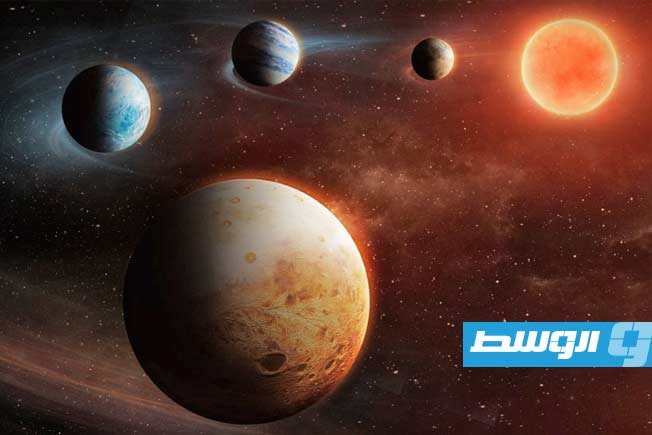
Astronomy enthusiasts and stargazers are preparing to welcome one of the most beautiful celestial displays of the year, as astronomers have announced a rare “six-planet alignment” occurring on the 28th of this February, a phenomenon that only repeats a few times each decade.
On the evening of February 28th, six planets from our solar system—Mercury, Venus, Mars, Jupiter, Saturn, and Neptune—will align to form a celestial arc decorating the sky’s dome. This phenomenon occurs when the planets line up in their orbits on one side of the Sun as seen from Earth, creating an imaginary line that gathers these distant celestial bodies into a single visual frame.
Experts explained that the ideal time for observation will be immediately after sunset, as the phenomenon will be visible from most parts of the world provided the sky is clear and the horizon is free of obstacles like tall buildings or mountains.
During the event, it will be easy to distinguish the planets Venus and Jupiter, as they will shine brightly as the most luminous objects in the sky after the Moon, while Mars and Saturn can be seen with the naked eye under good lighting conditions.
– In a unique astronomical phenomenon… the Sun sends a space kiss in the shape of a heart
– Astronomers observe a powerful and mysterious phenomenon in the universe
– The ‘Blood Moon’ phenomenon amazes observers during a total lunar eclipse
Observers may need binoculars or small telescopes to see Mercury and Neptune, due to their faint glow or proximity to the horizon.
A Golden Opportunity for Photographers and Researchers
This alignment is a golden opportunity for astrophotographers to document this rare scene and for families to introduce children to the wonders of the solar system. Although the planets appear close together in the sky, they are in fact separated by millions of kilometers in deep space, and what we see is merely an “optical illusion” resulting from our position in Earth’s orbit.
Astronomers advise those wishing to observe the event to stay away from urban light pollution as much as possible to get the best possible view of this unique cosmic tableau, confirming that such six-planet alignments are among the astronomical events worth waiting for.
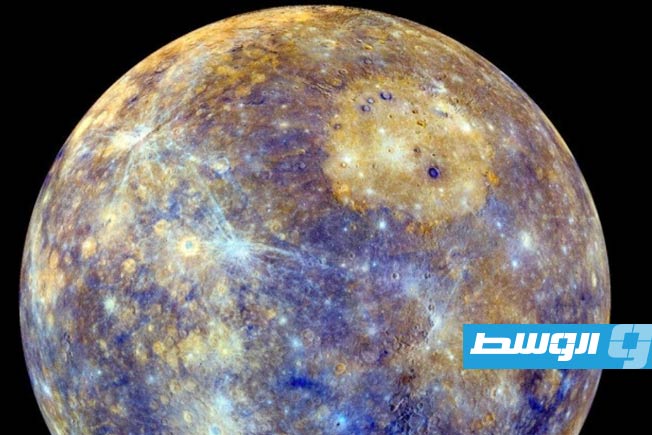
Mercury
Mercury is a chemical element with the symbol Hg and atomic number 80, historically known as quicksilver. It has been used since ancient times in applications such as gilding and thermometers, and it is the only metallic element that is liquid at standard room temperature.
Venus
Venus is the second planet from the Sun and is named after the Roman goddess of love and beauty. It has no known cultural sites, but its bright appearance in Earth’s sky has influenced mythology and astronomy for millennia.
Mars
Mars is the fourth planet from the Sun and is often called the “Red Planet” due to its iron oxide-rich surface. It has been a major focus of scientific exploration, with robotic missions revealing a history of ancient water flows and the potential for past habitability.
Jupiter
Jupiter is the largest planet in our solar system, a gas giant primarily composed of hydrogen and helium. It has been known since ancient times and is named after the king of the Roman gods. Its most distinctive feature is the Great Red Spot, a giant storm that has been raging for at least several centuries.
Saturn
Saturn is the sixth planet from the Sun and a gas giant in our solar system, known for its prominent ring system. It has been observed since ancient times and was named after the Roman god of agriculture and wealth, with its rings first identified by Galileo Galilei in 1610.
Neptune
Neptune is the Roman god of the sea, equivalent to the Greek god Poseidon, and was a major deity in ancient Roman religion and mythology. He was worshipped as the protector of waters and sailors, and his importance is reflected in the Roman festival of Neptunalia, held in July to petition for water during droughts.
Sun
The Sun is not a specific place or cultural site but the star at the center of our solar system. It has been central to human cultures throughout history, often worshipped as a deity in ancient civilizations like those of Egypt and Mesoamerica. Its predictable cycles have shaped calendars, agriculture, and mythologies worldwide.
Earth
Earth is the third planet from the Sun and the only known celestial body to harbor life, with a geological history spanning approximately 4.54 billion years. Human cultures and civilizations have developed across its diverse continents and ecosystems over hundreds of thousands of years, fundamentally shaping its modern environment.
Moon
The Moon is Earth’s only natural satellite, believed to have formed around 4.5 billion years ago from debris after a massive collision between Earth and a Mars-sized body. Culturally, it has been a central figure in mythology, timekeeping, and artistic inspiration across human civilizations throughout history.