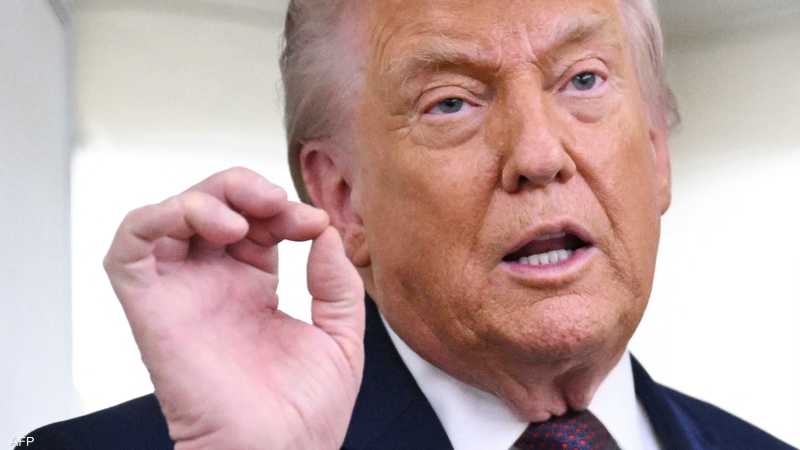
U.S. President Donald Trump praised the United Kingdom’s army after British Prime Minister Keir Starmer urged him to apologize for downplaying NATO forces in the war in Afghanistan, according to reports on Saturday.
The President did not offer a full apology in a social media post, but said the UK military is “second to none” and that its “great and very brave soldiers will always be with the United States.”
He wrote: “In Afghanistan, 457 military personnel lost their lives, many were seriously injured, and they were among the greatest warriors. It is a bond too strong to break.”
In an interview with Fox News on Thursday, Trump criticized the role of other countries in NATO during the 20-year conflict that began with the invasion of Afghanistan in 2001, stating that Washington “never needed them” and that allied forces “stayed away from the front lines.”
Trump and Starmer spoke on Saturday, following the latter’s description of the remarks as “insulting.”
In parallel, a spokesperson for the UK Prime Minister’s office said, “The Prime Minister spoke about the brave and heroic British and American soldiers who fought side by side in Afghanistan, many of whom never returned home,” adding, “We must never forget their sacrifices.”
Starmer had said on Friday: “I consider President Trump’s remarks to be insulting and frankly shocking,” adding that if he had misspoken in such a manner, he would “certainly apologize,” while praising the British soldiers who were killed.
Criticism of Trump widened on Saturday from NATO member states that participated alongside the United States in the invasion that toppled Taliban rule and aimed to eradicate Al-Qaeda following the September 11, 2001 attacks, with many of their forces remaining until the U.S. withdrawal in 2021.
Italian Prime Minister Giorgia Meloni expressed being “stunned.”
She said in a statement that “the Italian government was stunned by President Trump’s statement” that member states of the alliance “lagged behind during operations in Afghanistan.”
She continued: “Italy and the United States are bound by a strong friendship (…) but friendship requires respect, which is a prerequisite for continuing to uphold the solidarity that is the foundation of the Atlantic Alliance.”
Meloni affirmed that Rome “paid an indisputable price: 53 Italian soldiers killed and 700 wounded,” considering that “statements that diminish the contribution of NATO countries in Afghanistan are unacceptable, especially when coming from an allied nation.”
Sources also reported on Saturday that French President Emmanuel Macron reiterated the country’s “gratitude” to the families of French soldiers who fell in Afghanistan.
They said: “The unacceptable statements (from Trump) warrant no comment. What the head of state wants is to console the families of the fallen soldiers and reaffirm the nation’s gratitude and its respectful memory.”
French military involvement in Afghanistan lasted from 2001 until 2014, during which 89 French personnel were killed and more than 700 were wounded.
United States
The United States is a federal republic founded in 1776 after declaring independence from Great Britain, with its modern government established by the Constitution in 1789. Its history is marked by westward expansion, industrialization, and its emergence as a global superpower in the 20th century. The nation’s culture is a diverse blend of indigenous, European, African, and global immigrant influences.
United Kingdom
The United Kingdom is a sovereign nation comprising England, Scotland, Wales, and Northern Ireland, with a history of unification beginning with the Acts of Union in 1707. It evolved from a powerful global empire into a modern constitutional monarchy and parliamentary democracy, playing a central role in world events like the Industrial Revolution and both World Wars. Its rich cultural heritage is reflected in landmarks such as Stonehenge, Westminster Abbey, and Edinburgh Castle.
Afghanistan
Afghanistan is a historically significant crossroads of civilizations, with a rich cultural heritage shaped by empires like the Persian, Greek, and Mongol. Its landscape is home to ancient sites such as the Buddhas of Bamiyan and the Minaret of Jam, reflecting its role on the Silk Road. The modern nation has faced prolonged conflict and instability following invasions and wars in recent decades.
NATO
NATO, the North Atlantic Treaty Organization, is a military alliance established in 1949 by the United States, Canada, and several Western European nations to provide collective security against the Soviet Union during the Cold War. Its foundational principle is Article 5, which states that an attack on one member is considered an attack on all. Following the Cold War, NATO has expanded eastward and adapted its missions to include crisis management and counter-terrorism operations.
Washington
Washington, D.C., the capital of the United States, was founded in 1790 following the ratification of the U.S. Constitution and named after the nation’s first president, George Washington. It is a planned city, distinct from any state, and is home to iconic landmarks such as the White House, the U.S. Capitol, and the Washington Monument, which symbolize the federal government and American history.
Fox News
Fox News is a major American cable and satellite television news channel founded in 1996 by media mogul Rupert Murdoch. It was established to provide a conservative perspective in news broadcasting and has since become a highly influential and politically polarizing media outlet in the United States.
Taliban
The Taliban is a fundamentalist political and military movement that emerged in Afghanistan in the early 1990s following the Soviet withdrawal. It ruled most of the country from 1996 to 2001, enforcing a strict interpretation of Islamic law, and regained control in 2021 after the collapse of the Western-backed government.
Al-Qaeda
Al-Qaeda is a transnational militant Islamist organization founded around 1988 by Osama bin Laden and other veterans of the Soviet-Afghan War. It gained global notoriety for its jihadist ideology and for orchestrating the September 11, 2001, terrorist attacks on the United States. The group’s history is defined by its aim to establish a pan-Islamic caliphate and its conflict with Western powers and their allies.
September 11, 2001
The September 11, 2001 attacks were a series of coordinated terrorist attacks by the militant group al-Qaeda against the United States, primarily targeting the World Trade Center in New York City and the Pentagon near Washington, D.C. The attacks resulted in the collapse of the Twin Towers, the deaths of nearly 3,000 people, and led to major U.S. initiatives against terrorism, including the subsequent wars in Afghanistan and Iraq. The site of the World Trade Center is now home to the National September 11 Memorial & Museum, which honors the victims and preserves the history of the event.
Italy
Italy is a country in Southern Europe with a rich cultural history that dates back to the ancient Roman Empire, which was a foundational civilization for Western law, government, and engineering. It later became the epicenter of the Renaissance, producing unparalleled contributions to art, science, and architecture. Today, it is renowned for its historic cities, artistic masterpieces, and globally influential cuisine.
Rome
Rome is the capital city of Italy, founded according to legend in 753 BC, and it grew to become the epicenter of the vast Roman Empire. Today, it is renowned for its ancient ruins like the Colosseum and Roman Forum, as well as its profound influence on Western civilization, law, and art.
Atlantic Alliance
The Atlantic Alliance, commonly known as NATO (North Atlantic Treaty Organization), is a military and political alliance established in 1949 by the North Atlantic Treaty. It was founded primarily as a collective defense pact among Western nations to counter the threat posed by the Soviet Union during the Cold War, with its key principle being that an attack on one member is considered an attack on all.
France
France is a Western European country with a rich history that dates back to ancient Gaul, later becoming a major medieval kingdom and a leading global power from the 17th to 20th centuries. It is renowned for its profound cultural influence, from the Enlightenment and the French Revolution to its world-famous art, cuisine, and landmarks like the Eiffel Tower and the Palace of Versailles.