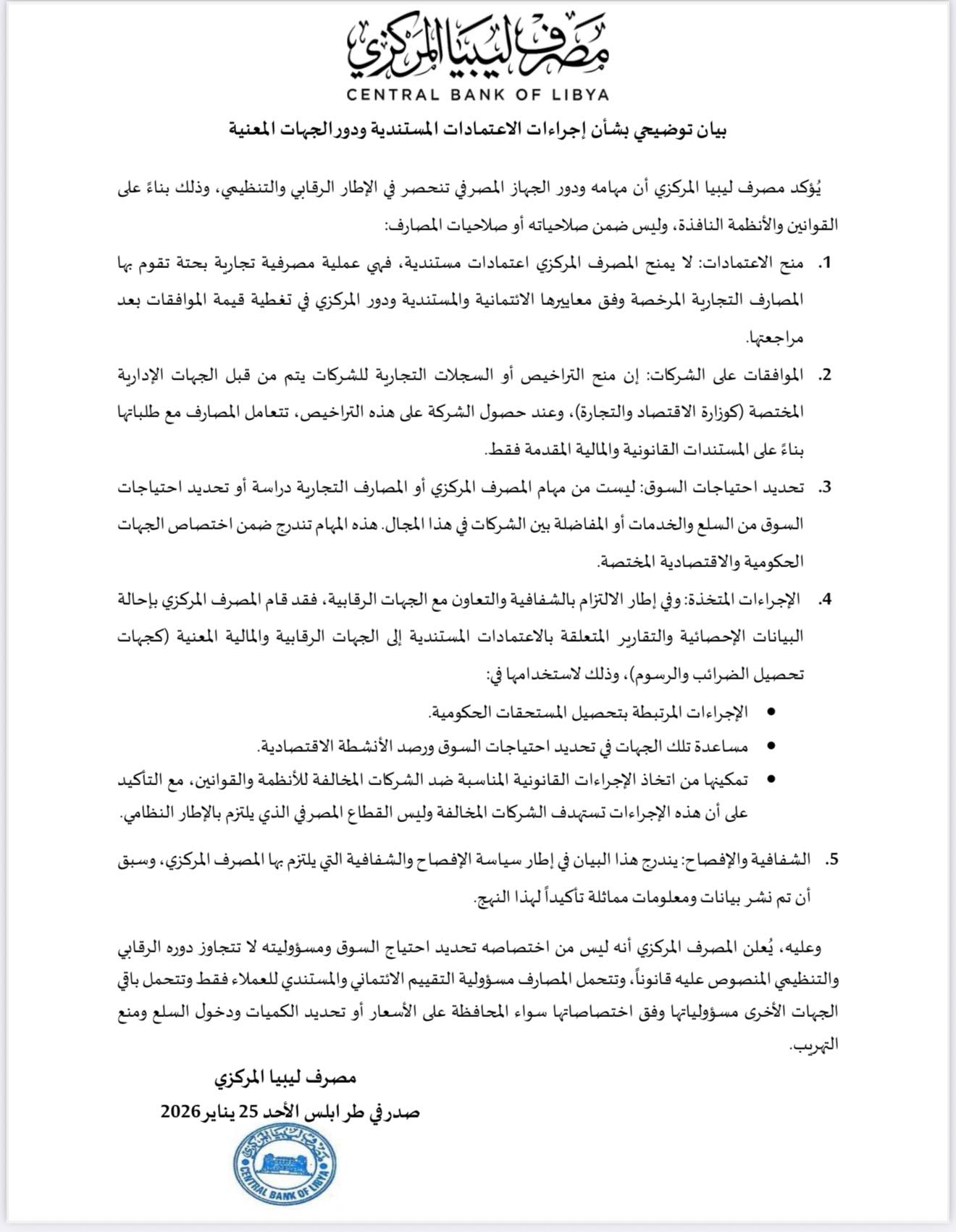
Tripoli, January 25, 2026 – The Central Bank of Libya stated in a clarification published today that its role in documentary credit procedures is limited to supervisory and regulatory aspects only and is not within its authority or the authority of banks, based on the applicable laws and regulations.
The statement confirmed that the Central Bank does not issue documentary credits, as this is a commercial banking process carried out by licensed commercial banks according to their credit and documentary standards, and that the Central Bank’s role is limited to covering the value of approvals after reviewing them.
The Central Bank pointed out in its statement that granting licenses or commercial registrations to companies is done by the relevant administrative authorities such as the Ministry of Economy and Trade, and once a company obtains these licenses, banks handle its requests based solely on the legal and financial documents submitted.
It also emphasized that determining market needs is not a task of the Central Bank or commercial banks, but rather a task of the relevant government and economic authorities, and the Central Bank’s role does not include this scope.
The statement clarified that the Central Bank has referred statistical data and reports related to documentary credits to the relevant supervisory and financial authorities, such as tax and fee collection bodies, to support procedures related to collecting government dues and assist these authorities in determining market needs and monitoring economic activities.
The Bank confirmed that these procedures target companies that violate regulations and laws, not the banking sector, which adheres to the applicable regulatory framework. It also noted that these steps are part of the transparency and disclosure policy adhered to by the Bank, similar data and information regarding which have been published previously.
The Central Bank indicated that this statement comes within the framework of the disclosure and transparency policy adhered to by the Central Bank, similar data and information regarding which have been published previously to confirm this approach.
The statement concluded by affirming that the Central Bank of Libya remains committed to its legally mandated supervisory and regulatory role, and that commercial banks bear the responsibility for the credit and documentary evaluation of clients, while other government authorities bear their responsibilities according to their mandates, whether in price control, quantity determination, goods entry, or smuggling prevention.
…