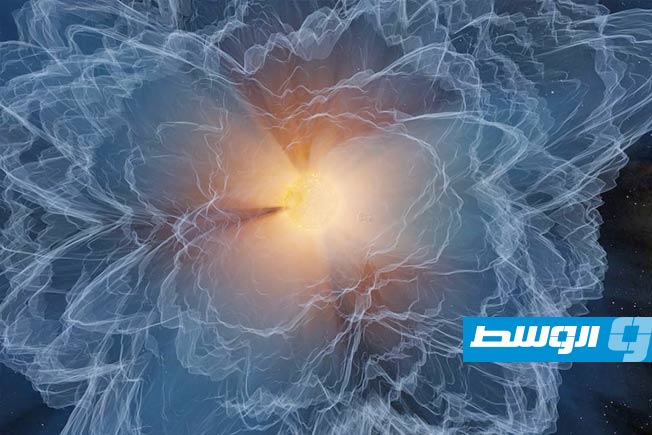
A recent astronomical study, based on precise observations of aging stars in the Milky Way galaxy, has revealed the detailed features of the future of the Sun and the solar system when they reach the stage of “cosmic death.”
The study noted that monitoring Sun-like stars in their final phases gives scientists a temporal “roadmap” of what will happen to planet Earth and its surroundings after billions of years.
The study highlighted the “Helix Nebula,” which astronomers nickname the “Eye of Sauron” due to its majestic shape resembling a giant human eye.
This nebula, located 650 light-years away in the constellation Aquarius, is one of the closest examples of a so-called “planetary nebula,” the state a star reaches after exhausting its hydrogen fuel.
– A cosmic “shadow” reveals a galaxy cluster defying astrophysical laws
– Giant cosmic ripples shake the Milky Way’s disk
– A recent study determines the date of the end of the universe
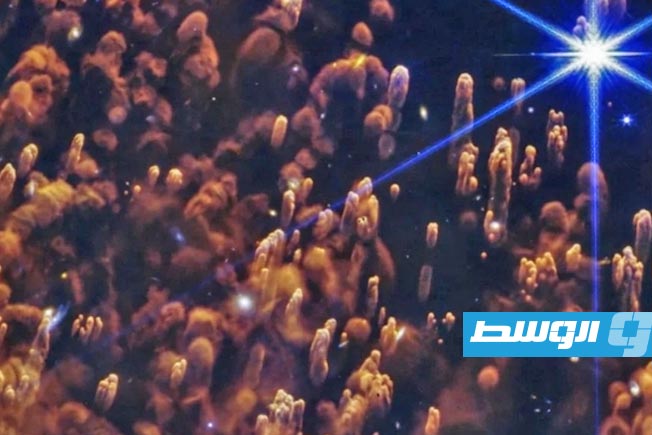
While the Hubble telescope previously provided iconic images of this nebula, the James Webb Space Telescope has taken the study to a new level of precision, revealing nearly 40,000 dense, comet-like gaseous knots resisting the violent radiation from the central star.
Researchers confirmed that each of these “knots” covers an area exceeding the orbit of Pluto in the solar system, although they are much less dense.
The Sun’s Demise Scenario
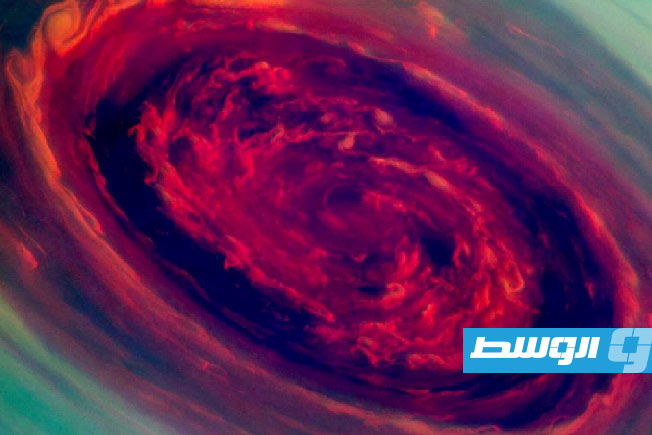
The study explained that the Sun will go through the same stages; it will swell to become a “red giant,” then lose gravitational control over its outer layers, ejecting them into space as glowing gases and leaving behind a “white dwarf” that slowly cools over billions of years.
The study mentioned that the materials ejected by the nebula, laden with complex chemical elements, will mix with the interstellar medium to become part of a new generation of stars and planets.
Scientists believe that the carbon and oxygen atoms we see today in the Helix Nebula may one day settle into a “primordial soup” on the surface of a new rocky planet, beginning another life cycle.
James Webb Telescope
The James Webb Space Telescope is a large infrared observatory launched in 2021, developed as the scientific successor to the Hubble Space Telescope through an international collaboration led by NASA. Its mission is to study every phase of cosmic history, from the first luminous glows after the Big Bang to the formation of galaxies, stars, and planetary systems.
Helix Nebula
The Helix Nebula, also known as the “Eye of God,” is a planetary nebula located about 650 light-years away in the constellation Aquarius. It was formed from the outer layers of a sun-like star expelled at the end of its life, with the central white dwarf remnant illuminating the expanding gas cloud.
Milky Way galaxy
The Milky Way galaxy is a barred spiral galaxy that contains our Solar System, with its name derived from its milky, band-like appearance in the night sky. It is estimated to be over 13 billion years old and formed from the gravitational collapse of a region within a large molecular cloud.
Sun
The Sun is the star at the center of our solar system, formed approximately 4.6 billion years ago from the gravitational collapse of a giant molecular cloud. It has been the central object of worship and study in numerous ancient cultures, from the sun gods of Egypt and Mesoamerica to the foundational observations of astronomers like Galileo.
solar system
The Solar System is a planetary system consisting of the Sun and the objects gravitationally bound to it, including eight major planets, their moons, and numerous smaller bodies. It formed approximately 4.6 billion years ago from the gravitational collapse of a giant interstellar molecular cloud.
Earth
Earth is the third planet from the Sun and the only known astronomical object to harbor life. Its geological history spans over 4.5 billion years, with the development of complex life forms occurring over hundreds of millions of years within its unique biosphere.
Eye of Sauron
The “Eye of Sauron” is a fictional symbol from J.R.R. Tolkien’s *The Lord of the Rings*, representing the all-seeing power and malevolent will of the dark lord Sauron. In the narrative, it is depicted as a great fiery eye atop the Dark Tower of Barad-dûr in the land of Mordor, constantly searching for the One Ring.
Aquarius
The Aquarius is a historic theater located in Frankfurt, Germany, which opened in 1908. Originally a venue for variety shows and later a cinema, it is now primarily known as a popular concert and event location, having hosted numerous notable musical acts over the decades.
Hubble telescope
The Hubble Space Telescope is a space-based observatory launched by NASA in 1990, which has revolutionized astronomy by providing unprecedented deep-space images free from Earth’s atmospheric distortion. Its history includes a crucial 1993 servicing mission to correct a flaw in its primary mirror, allowing it to fulfill its mission of expanding our understanding of the universe’s age, expansion, and celestial phenomena.
James Webb Space Telescope
The James Webb Space Telescope (JWST) is a large infrared space observatory launched in 2021, developed as the scientific successor to the Hubble Space Telescope through an international collaboration led by NASA. Its mission is to study the formation of the universe’s first galaxies, the birth of stars and planetary systems, and the atmospheres of exoplanets.
Pluto
Pluto is a dwarf planet located in the Kuiper Belt, discovered in 1930 by American astronomer Clyde Tombaugh. It was historically considered the ninth planet in our solar system until 2006, when the International Astronomical Union reclassified it due to its size and orbital characteristics.
white dwarf
A white dwarf is not a place or cultural site, but a type of astronomical object. It is the dense, hot remnant of a star like the Sun that has exhausted its nuclear fuel and shed its outer layers, leaving behind a cooling core primarily composed of carbon and oxygen.