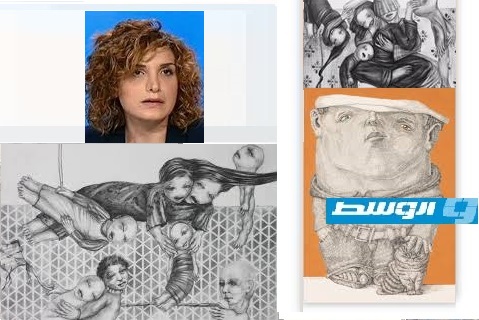
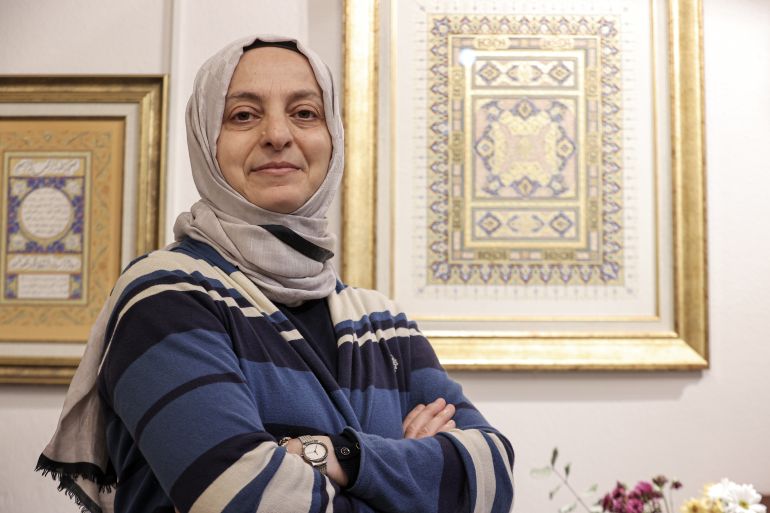
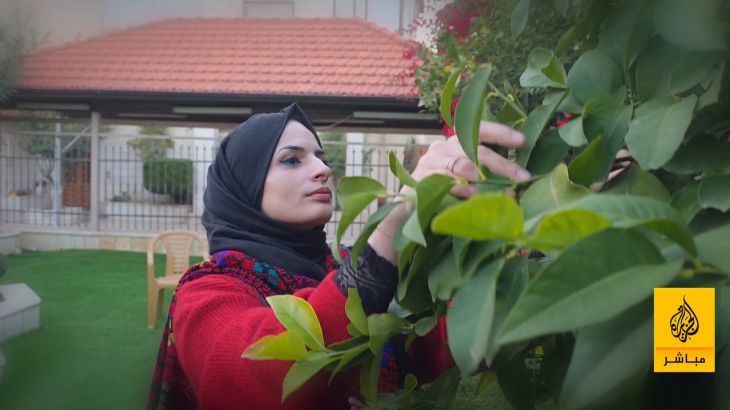
The Syrian visual artist Randa Maddah was born in 1983 in the village of Majdal Shams in the occupied Syrian Golan Heights. After completing a course in drawing and sculpture at the Adham Ismail Center in Damascus in 2003, she graduated from the University of Damascus – Faculty of Fine Arts – Sculpture Department in 2005. In 2007, she undertook a tour at the Academy of Musical Arts in Jerusalem.
Painting is something imaginary that becomes reality through feeling.
Originating from the Golan Heights plateau, occupied by Israel in southwestern Syria—a community with a firm belief in concepts of reincarnation and resurrection—these themes are clearly evident in Maddah’s poetic and melancholic paintings, where fairy-like creatures float in wondrous environments. She says: “In art, you paint a picture of something imaginary, which becomes reality through feeling.”
Her bold pictorial work reflects political reality.
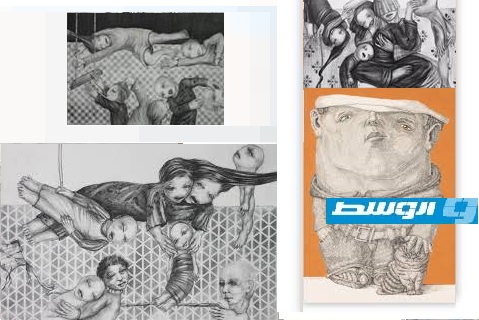
The artist, who resides in Paris, speaks of her upbringing amidst the stunning landscapes of the Golan Heights plateau, her studies in Palestine, and how her bold pictorial work reflects political reality. Through paintings that are merely elegant miniature “portraits,” the artist’s sense of body and landscape merges, blurring the boundaries between living beings and plants, making them appear rooted yet simultaneously light, swaying in the breeze, where growth and decay coexist, and endings lead to new beginnings. Her figures hover between wakefulness and sleep, intertwined with vines.
Through works about her village in the civilian Golan Heights plateau, Randa Maddah addresses issues of memory, denial, and homeland. It is said: “Those independent from the majority are often not in disagreement about remembering how things were before their country was subjected to destruction.” Maddah uses various materials and drawings, including drawing on paper and decorative panels, focusing on depicting bodies and composite scenes. In one video work, she used mirrors reflecting different scenes, and in another, she employed the ruins of an uninhabitable destroyed city that will remain, in a renewed conceptualization of denial and memory.
Maddah participated in the Palest’In & Out festival in Paris and Morocco. She was also selected for the Young Artist of the Year list, organized by a foundation, and received the Excellence Award and the International Grand Prize for Arts Defense in Japan.
The end is merely a new beginning.
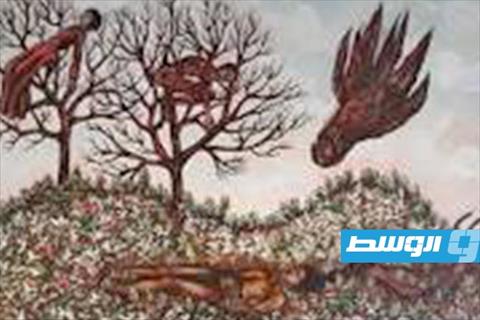
Randa Maddah is a founding member of an art center in the occupied Golan Heights, which serves as a dedicated space for contemporary art and art education there, founded by young artists. In Randa Maddah’s view, the end is merely a new beginning, so her painting “Lullaby” takes us on a dream-like journey, where light shimmers and warmth gathers in the soil.
In this work, Randa Maddah imagines resurrection through a garden, a space that breathes and pulses with renewal. Through precise miniature portrait paintings, the artist merges body and landscape until the boundaries between flesh and plants fade, making them appear rooted yet lightweight.
Maddah consistently evokes the garden as a metaphor for life cycles in her art, where growth and decay coexist, and endings lead to new beginnings. Her figures hover between wakefulness and sleep—not fully here nor fully elsewhere—intertwined with the vine.
Majdal Shams
Majdal Shams is the largest Druze village in the Israeli-occupied Golan Heights. Historically part of Syria, it came under Israeli control following the 1967 Six-Day War, and many of its residents maintain Syrian identity and allegiance. The village is known for its agricultural production, particularly apples, and is a cultural center for the Druze community in the region.
Syrian Golan Heights
The Syrian Golan Heights is a strategically important plateau that was part of Syria until it was captured by Israel during the 1967 Six-Day War. Israel later annexed the territory in 1981, a move not recognized internationally, and the area remains a major point of contention in the Arab-Israeli conflict.
Adham Ismail Center
The Adham Ismail Center is a cultural institution in Damascus, Syria, dedicated to preserving and promoting Syrian visual arts. It is named after Adham Ismail (1922-1963), a pioneering Syrian modernist painter known for blending abstract and calligraphic styles. The center serves as a gallery and hub for artistic activities, honoring his legacy within the nation’s cultural history.
Damascus
Damascus is the capital of Syria and one of the oldest continuously inhabited cities in the world, with evidence of settlement dating back to the third millennium BCE. It served as a major cultural and commercial center, notably as the capital of the Umayyad Caliphate in the 7th and 8th centuries, and is home to significant historical sites like the Umayyad Mosque.
University of Damascus
The University of Damascus, founded in 1923, is the oldest and largest university in Syria. It originated from earlier institutions, including a medical school established in 1903, and has since grown into a major center for higher education and research in the Arab world.
Faculty of Fine Arts
The Faculty of Fine Arts in Lima, Peru, is the oldest art school in the Americas, founded in 1918 by painter Daniel Hernández. It was established to promote and professionalize artistic education in the country, becoming a central institution in the development of Peruvian modern art.
Sculpture Department
The Sculpture Department is an academic division within art schools or universities dedicated to the study and practice of three-dimensional art forms. Its history is tied to the formalization of fine arts education, evolving from traditional atelier training to incorporate modern and contemporary techniques and theories.
Academy of Musical Arts
The Academy of Musical Arts is a prestigious institution dedicated to the education and training of musicians, often with a history rooted in the 19th or early 20th centuries as part of broader cultural movements. These academies typically serve as conservatories, preserving classical traditions while fostering new musical talent and innovation. Their founding is frequently linked to efforts by national governments or philanthropic patrons to formalize and elevate the study of music within their societies.
Jerusalem
Jerusalem is a historic city sacred to Judaism, Christianity, and Islam, with a history spanning thousands of years. It has been conquered, destroyed, and rebuilt numerous times, serving as the capital of the ancient Israelite kingdom and later as a central site during the Crusades. Its Old City contains major religious sites including the Western Wall, the Church of the Holy Sepulchre, and the Al-Aqsa Mosque compound.
Golan Heights
The Golan Heights is a strategically important plateau located in the Levant, currently mostly administered by Israel but internationally recognized as Syrian territory. It was captured by Israel from Syria during the Six-Day War in 1967, and its status remains a central point of contention in the Arab-Israeli conflict.
Israel
Israel is a country in the Middle East, established as a modern state in 1948 following a United Nations partition plan. It is a historic homeland of the Jewish people, with Jerusalem containing sites sacred to Judaism, Christianity, and Islam.
Syria
Syria is a country in the Middle East with a rich history as a cradle of civilization, home to ancient cities like Damascus, one of the world’s oldest continuously inhabited cities. Its historical landscape includes significant archaeological sites from various empires, such as Palmyra and the Crusader castle Krak des Chevaliers, though many have suffered damage during recent conflicts.
Paris
Paris is the capital of France, historically founded as the Roman town of Lutetia in the 3rd century BC. It is globally renowned as a center for art, fashion, and culture, home to iconic landmarks like the Eiffel Tower, the Louvre Museum, and Notre-Dame Cathedral.
Palestine
Palestine is a historical and geographic region in the Eastern Mediterranean, with a deeply layered history of Canaanite, Israelite, Roman, Byzantine, Islamic, and Ottoman rule. It is central to the Abrahamic religions and is the location of significant holy sites like Jerusalem’s Al-Aqsa Mosque and the Church of the Holy Sepulchre. In the modern era, it is at the heart of a protracted political and territorial conflict between Israelis and Palestinians.
Japan
Japan is an island nation in East Asia with a history spanning over a millennium, evolving from a feudal shogunate system into a modern constitutional monarchy. It is renowned for its unique cultural sites, such as ancient Shinto shrines, Buddhist temples, and historic castles, which reflect its deep traditions and periods like the Heian and Edo eras. Today, Japan blends this rich heritage with cutting-edge technology and contemporary pop culture.
Morocco
Morocco is a North African country with a rich history shaped by indigenous Amazigh (Berber) cultures, Arab influence from the 7th century, and successive dynasties like the Almoravids and Almohads. Its cultural sites, such as the ancient city of Fez and the Koutoubia Mosque in Marrakech, reflect this blend of Arab, Islamic, and Amazigh heritage. The country’s historic medinas, kasbahs, and varied landscapes from the Sahara Desert to the Atlas Mountains contribute to its distinct cultural identity.