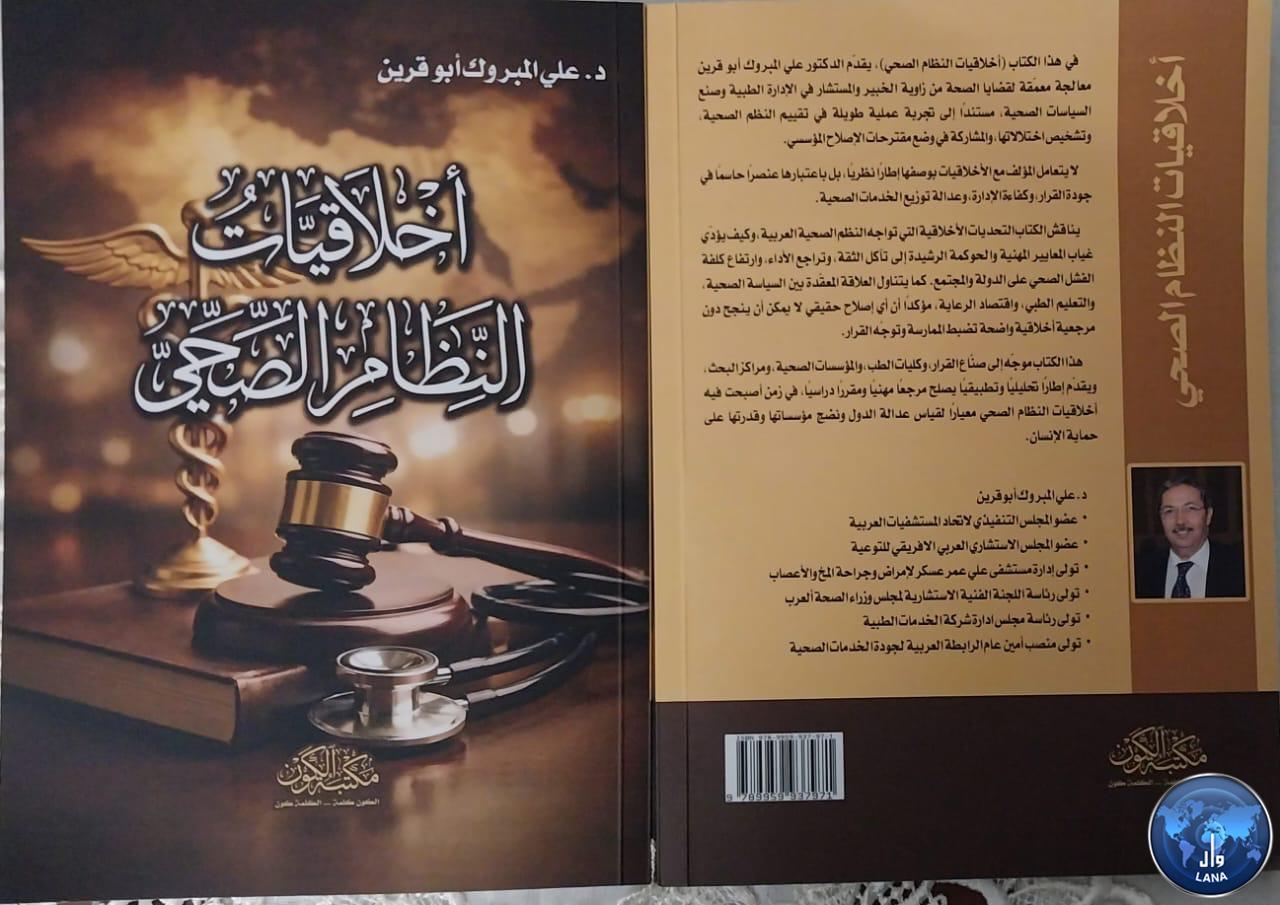
Tripoli, January 24, 2026 – A new book titled “Ethics of the Health System” has recently been published.
The book provides an in-depth analysis of health issues from the perspective of specialization, expertise, and practice in health management, health policy-making, and standards, drawing on extensive practical experience in evaluating health systems, diagnosing their dysfunctions, and participating in developing proposals for institutional reform.
It was stated that the book does not treat ethics merely as a theoretical framework but considers it a crucial element in decision quality, management efficiency, and the fairness of health service distribution.
It was clarified that the book addresses the ethical challenges facing Arab health systems, and how the absence of professional standards and sound governance leads to eroded trust, declining performance, and increased costs of health system failures for the state and society. It also examines the complex relationship between health policy, medical education, and the economics of care.
It was emphasized that any genuine reform cannot succeed without a clear ethical reference to regulate practice. The book is directed at decision-makers, medical schools, health institutions, and research centers, providing an analytical and applied framework suitable as a professional reference and a course textbook at a time when health system ethics have become a standard for measuring a state’s fairness, the maturity of its institutions, and its capacity to protect people.