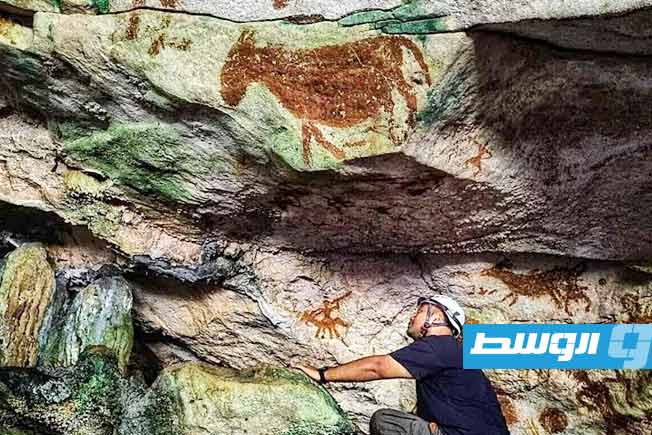
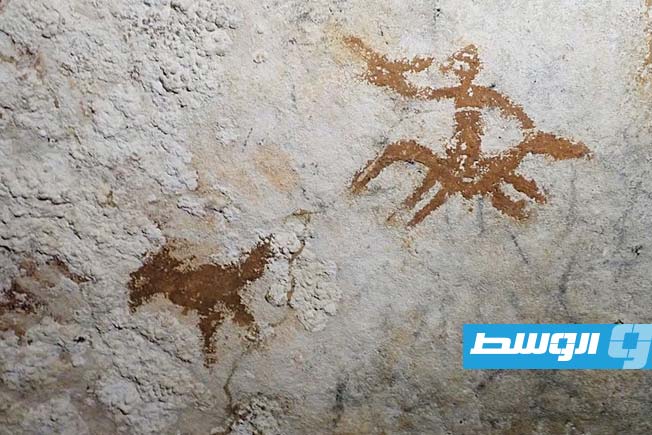
A team of researchers from Indonesia and Australia has discovered what is believed to be the world’s oldest cave art on the Indonesian island of Sulawesi, where hand stencils dating back at least 67,800 years were found.
A study, whose results were published in the scientific journal ‘Nature’, revealed that the researchers discovered an artistic technique based on blowing pigment over hands placed on the walls. They noted deliberate modifications to make the fingertips appear pointed, indicating early artistic skill and symbolic awareness.
Scientists suggest that these drawings may belong to the ancient ‘Denisovan’ human groups that inhabited the region, or to the earliest modern humans who migrated from Africa to Australia during that time period.
–
–
–
According to the study, these hand stencils reflect a sophisticated cultural tradition, reshaping the historical understanding of the beginnings of human creativity and its development in the Southeast Asia region.
A key center of early human heritage
This discovery opens new avenues for research into the interaction between ancient human groups and their capacity for artistic expression. The study states that “the island of Sulawesi represents one of the most important centers of early human heritage.”
It adds that “accurately dating these paintings establishes them as the oldest physical evidence of mural art discovered to date, surpassing previous records set in other parts of the world.”
Indonesia
Indonesia is a Southeast Asian archipelago of over 17,000 islands, historically shaped by Hindu-Buddhist kingdoms, Islamic sultanates, and Dutch colonial rule before declaring independence in 1945. Its diverse culture is reflected in thousands of ethnic groups and languages, with notable sites including the Buddhist temple of Borobudur and the Hindu complex of Prambanan.
Australia
Australia is a continent and nation with a history spanning over 65,000 years of continuous Indigenous culture, followed by British colonization beginning in 1788. It is known for its unique ecosystems, modern multicultural cities, and landmarks like the Sydney Opera House and Uluru.
Sulawesi
Sulawesi is a large, uniquely shaped island in Indonesia, historically home to various kingdoms and known for its ancient megalithic cultures and intricate Toraja funeral traditions. It played a significant role in regional trade and was later influenced by Dutch colonialism. Today, it is renowned for its exceptional biodiversity, both on land and in its surrounding marine ecosystems.
Nature
Nature, in a cultural context, often refers to the natural world as a source of inspiration, spiritual significance, and a subject of preservation. Historically, many cultures have revered natural sites as sacred, from ancient animistic traditions to the establishment of national parks in the modern era. This relationship reflects humanity’s evolving understanding of and dependence on the environment.
Africa
Africa is the world’s second-largest continent, known as the cradle of humankind due to archaeological evidence showing the origins of human evolution. It is home to immense cultural and historical diversity, with ancient civilizations like Egypt, Mali, and Great Zimbabwe, and was profoundly shaped by colonialism in the modern era.
Southeast Asia
Southeast Asia is a diverse geographic and cultural region comprising mainland nations like Vietnam and Thailand, as well as archipelagic states such as Indonesia and the Philippines. Historically, it has been shaped by indigenous kingdoms, as well as significant influences from Indian, Chinese, Islamic, and later European colonial powers. This complex history is reflected in its wide array of languages, religions, and architectural heritage sites.