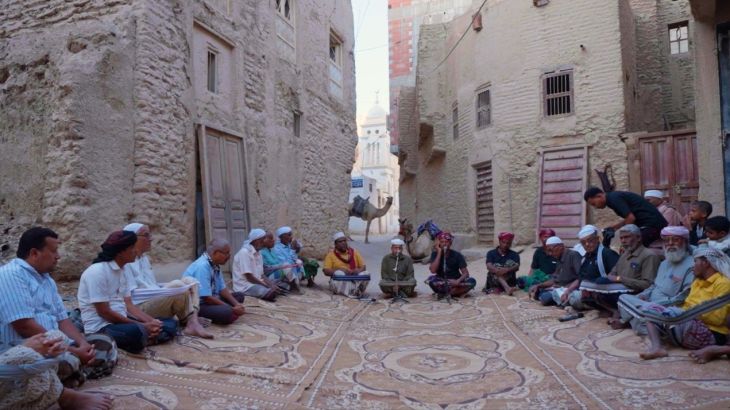
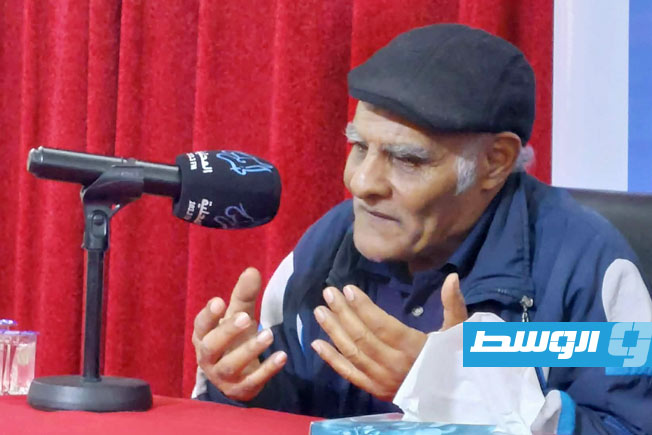
An episode of the art of “Hadrami Dan” in Yemen was documented. This art form has been included by the United Nations Educational, Scientific and Cultural Organization (UNESCO) on its list of Intangible Cultural Heritage.
UNESCO’s decision reflects international recognition of the value of this ancient Yemeni art and an appreciation of its place in Hadrami memory and the Yemeni consciousness.
Hadrami Dan is an authentic folk lyrical art that combines improvised poetry and poignant melodies. It is distinguished by the repetitive chant “dan” which gives it its unique musical character, alongside various maqamat (melodic modes) performed in a spirit of collective tradition.
This art is performed in special sessions known as “Dan sessions.” Its musical styles vary from one area to another within Hadramaut, making it a firmly rooted element in the cultural and historical identity of the province.
The musical styles of Dan are diverse, varying across different regions within Hadramaut.
Dan is characterized by a unique performance style that relies on harmony between voice and rhythm. It has been passed down orally through generations over many decades until reaching the platform of global recognition.
Preparing the file related to Hadrami Dan for submission to UNESCO took two years.
In December of last year, UNESCO inscribed 12 elements of Arab culture on its list of Intangible Cultural Heritage. These included dishes, clothing, cultural gatherings, and ancient social practices.
Among the elements inscribed were the Arab robe, the “Bisht,” the traditional Moroccan Caftan, the Egyptian dish Koshari, the Kuwaiti Diwaniya, the Jordanian Al-Mihras tree, the Iraqi game “Al-Muhais,” traditional wedding processions in a number of Arab countries, Kohl (eyeliner), and Bedouin Sadu weaving.
Several criteria are considered when inscribing a practice or craft on UNESCO’s Intangible Cultural Heritage list. Among them is that it must be transmitted from generation to generation and kept alive by a community.
Yemen
Yemen is a country on the southern tip of the Arabian Peninsula with a rich history as a center of ancient civilizations and trade, notably the Sabaean Kingdom associated with the legendary Queen of Sheba. It is home to significant cultural sites like the Old City of Sana’a, with its distinctive multi-story tower houses, and the historic port of Aden. The region’s history includes various Islamic caliphates and sultanates, though in recent decades it has been affected by prolonged conflict.
Hadrami Dan
Hadrami Dan is a traditional residential quarter in the city of Tarim, Yemen, historically inhabited by the Hadhrami diaspora who returned from Southeast Asia. The area is renowned for its distinctive architecture, featuring ornate wooden doors and elaborate stucco work that reflect a blend of local Yemeni and Southeast Asian influences.
United Nations Educational, Scientific and Cultural Organization
UNESCO, founded in 1945, is a specialized agency of the United Nations aimed at promoting world peace and security through international cooperation in education, the sciences, and culture. It is perhaps best known for its World Heritage program, which identifies, protects, and preserves cultural and natural heritage sites around the globe considered to be of outstanding value to humanity.
UNESCO
UNESCO, or the United Nations Educational, Scientific and Cultural Organization, is a specialized agency of the UN founded in 1945 to promote world peace and security through international cooperation in education, the sciences, culture, and communication. It is best known for its World Heritage program, which identifies, protects, and preserves cultural and natural heritage sites around the globe considered to be of outstanding value to humanity.
Hadramaut
Hadramaut is a historical region in southern Yemen, renowned for its ancient civilization and as a center of the incense trade. It is home to distinctive mudbrick skyscraper architecture, particularly in cities like Shibam, and was a key part of the South Arabian kingdoms. The region has a long history of emigration, with a diaspora community historically influential across the Indian Ocean.
Arab robe
The “Arab robe,” often called a thawb or dishdasha, is a traditional ankle-length garment worn widely across the Arab world. Its history dates back centuries, with its simple, loose-fitting design being ideally suited to the region’s hot, arid climate and reflecting cultural values of modesty. While styles, fabrics, and embellishments vary by country and occasion, it remains a powerful and enduring symbol of Arab identity and heritage.
Bisht
Bisht is a traditional men’s cloak historically worn across the Arabian Peninsula, particularly in Saudi Arabia, the UAE, and other Gulf states. It is a symbol of prestige and is often crafted from fine materials like wool or camel hair, and is traditionally worn over a thobe for formal occasions such as weddings, Eid, or by royalty and religious leaders. Its history is deeply rooted in Bedouin culture, serving as practical protection from the desert climate while evolving into a garment denoting high social status and honor.
traditional Moroccan Caftan
The traditional Moroccan caftan is a long, elegant garment with origins dating back to the 12th-century Almohad dynasty, originally influenced by Ottoman and Andalusian styles. It evolved as a symbol of status and cultural identity, traditionally worn for celebrations and ceremonies, and is distinguished by its intricate embroidery, luxurious fabrics, and fine craftsmanship.
Egyptian dish Koshari
Koshari is a popular Egyptian street food dish consisting of a hearty mixture of rice, lentils, chickpeas, and pasta, topped with a spiced tomato sauce and crispy fried onions. Its origins are debated, but it likely emerged in the late 19th century, potentially influenced by Indian *khichri* and adapted with Italian and Middle Eastern ingredients to become a uniquely Egyptian national dish.
Kuwaiti Diwaniya
The Kuwaiti Diwaniya is a traditional social and political gathering space, often a separate room in a private house, where men convene to discuss community affairs. Historically, these gatherings have been central to Kuwait’s consultative governance and social cohesion, serving as informal forums for debate and decision-making long before the establishment of modern political institutions.
Jordanian Al-Mihras tree
The Jordanian Al-Mihras tree is a centuries-old Atlantic pistachio tree located near the town of Sabha, believed to be the site where the Prophet Muhammad rested during his journey from Mecca to Damascus as a young merchant. It is considered a significant cultural and historical landmark, serving as a place of visitation and reverence.
Iraqi game Al-Muhais
Al-Muhais is a traditional Iraqi board game, often played with stones or seeds on a carved wooden board or in the sand. Its history dates back centuries, with roots in ancient Mesopotamian culture, and it remains a popular pastime that reflects the region’s long-standing social and recreational traditions.
Kohl
Kohl is a traditional cosmetic, typically a dark powder, that has been used since ancient times in regions like North Africa, the Middle East, and South Asia to darken the eyelids. Historically, its use dates back to ancient Egypt, where it was believed to have protective and medicinal properties against eye ailments and the sun’s glare. It remains a significant cultural and aesthetic practice in many communities today.
Bedouin Sadu weaving
Sadu weaving is a traditional Bedouin craft from the Arabian Peninsula, characterized by geometric patterns and vibrant colors woven on a ground loom. Historically, it was practiced by Bedouin women to create essential items like tents, carpets, and camel trappings, with the designs often symbolizing tribal identity and the desert environment. Today, it is recognized by UNESCO as an Intangible Cultural Heritage, representing a vital part of Bedouin cultural heritage.