A recent study proposes a new explanation for the difference between the ‘polar storms’ on Jupiter and Saturn and the deep internal characteristics of the two planets. The hypothesis suggests that Jupiter’s atmosphere imposes constraints that prevent storms from merging, while Saturn’s atmosphere allows them to grow and unite freely.
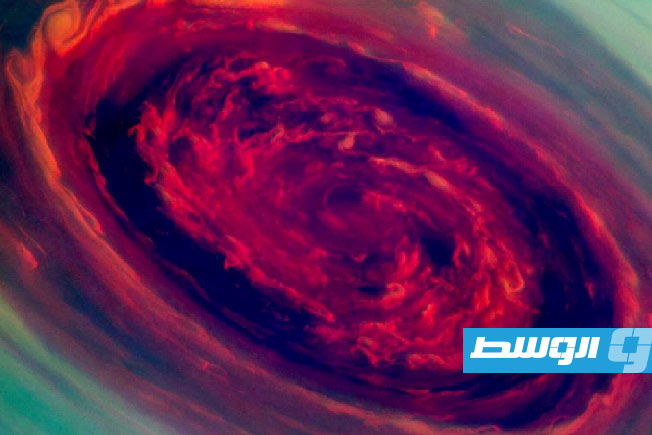
The study comes after decades of scientists puzzling over the mystery of the differing polar storms between the two planets, despite their great similarity in composition and speed. While Saturn features a single giant storm at each pole, Jupiter is characterized by a complex system consisting of a major central storm surrounded by a halo of smaller storms in a unique geometric formation.
It is indicated that the ‘vorticity at the base of the vortex’ is the primary driver of the fluid pattern observed on the surface.
According to the developed model, Saturn’s base appears more rigid and cohesive compared to Jupiter’s, leading to completely different outcomes. Jupiter’s atmosphere is characterized by high thermal energy emanating from its core, with relatively low friction. These conditions allow for the emergence of multiple vortices, but they generate early disturbances that act as barriers preventing these vortices from merging, thus remaining separate in a formation resembling a ‘pizza’.
– Vera Rubin Observatory Shakes Up Astronomy: Discovery of Asteroids Defying Physics Laws
– Video: Study Uncovers Mystery of Giant Ice Balls and Storm Phenomenon on Jupiter
– Saturn’s Giant Rings to Disappear by 2025
In contrast, Saturn possesses a deeper atmosphere where deep turbulence is reduced or energy dissipates more rapidly through friction. This absence of barriers allows all the small storms to collide and merge until they form one enormous polar cyclone.
A Window into Planetary Depths
The research relied on a two-dimensional model of fluid dynamics, taking advantage of the fact that fluid motion in rapidly rotating planets tends to organize along the axis of rotation.
It is suggested that what we see on the surface is actually a mirror of what happens in the depths; Saturn’s interior may be richer in metals and condensable materials, making it more cohesive than Jupiter’s.
The study’s results open new horizons for understanding the formation of gas giant planets. They prove that the violent weather observed by spacecraft like Juno and Cassini is not merely a surface phenomenon, but an encoded message carrying details of the geological and chemical structure hidden beneath thousands of kilometers of gas.