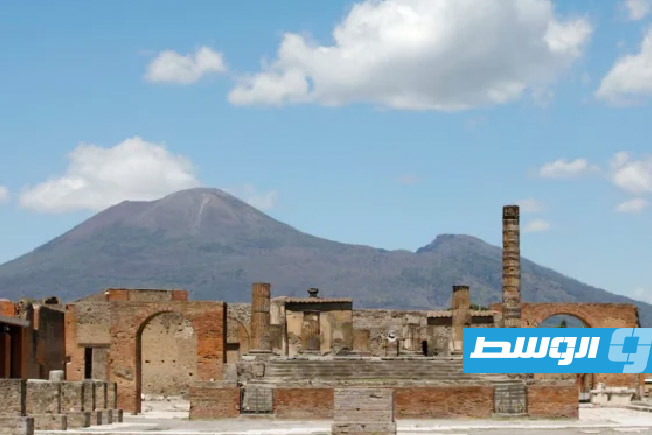
A revolutionary imaging technique has revealed secrets hidden for centuries on the ancient walls of Pompeii, Italy, bringing to light love messages, scenes of gladiatorial combat, and a series of daily insults and confessions, among about 80 inscriptions never seen before.
Pompeii was buried in 79 AD under tons of ash from Mount Vesuvius, which helped preserve its buildings and wall writings under layers of ash until its rediscovery in the 18th century, making it today one of the world’s most important archaeological sites.
These latest discoveries were found carved into the plaster of a long corridor connecting the city’s theaters with the vital Via Stabiana street, a site first uncovered more than 230 years ago.
Researchers relied on an advanced computational imaging technique known as Reflectance Transformation Imaging (RTI), which captures images of objects from multiple lighting angles. This allowed for the detection of fine scratches and recessed details that were invisible to the naked eye due to erosion.
–
–
–
Although the surface was previously considered well-documented, this work revealed about 300 inscriptions, including 79 texts and images appearing for the first time.
The ‘Whispers of the Corridors’ Project
This discovery is part of the ‘Whispers of the Corridors’ project.
The site’s director described this technique as “the key that opens new horizons in the ancient world,” noting that Pompeii contains more than 10,000 inscriptions that form a vast human legacy.
Among the texts previously known is an emotional farewell, and another inscription documenting the devotion of the slave girl ‘Methe’ to her beloved ‘Crestus’ and her supplication to the Roman goddess of love, Venus.
The new discoveries included a faded drawing of gladiators in combat and the beginning of a mysterious love declaration that reads: “Erato loves…”.
The team is currently developing a 3D platform that will provide a complete visual presentation of these inscriptions with explanatory notes, ensuring these voices from the past remain accessible to future generations.
Pompeii
Pompeii was a thriving Roman city near modern Naples that was buried under volcanic ash and pumice during the catastrophic eruption of Mount Vesuvius in 79 AD. The site lay largely preserved and forgotten until its rediscovery in the 18th century, and its excavated ruins now provide an extraordinarily detailed snapshot of daily life in the Roman Empire.
Italy
Italy is a country in Southern Europe with a rich cultural history that dates back to the Roman Empire, which was one of the largest and most influential civilizations of antiquity. It later became the birthplace of the Renaissance, a period of immense artistic and intellectual achievement centered in cities like Florence and Rome. Today, Italy is renowned for its vast contributions to art, architecture, cuisine, and fashion, and it hosts numerous UNESCO World Heritage Sites.
Mount Vesuvius
Mount Vesuvius is a stratovolcano in Italy most famous for its catastrophic eruption in AD 79, which buried the Roman cities of Pompeii and Herculaneum. It remains the only active volcano on mainland Europe and is a key site for volcanological study, with its history providing crucial insight into ancient Roman life and volcanic hazards.
Via Stabiana
Via Stabiana is one of the main thoroughfares in the ancient Roman city of Pompeii, connecting the city’s gates and leading toward the town of Stabiae. Excavations have revealed well-preserved shops, homes, and infrastructure along its path, offering significant insight into daily Roman life before the city was buried by the eruption of Mount Vesuvius in 79 AD.
Venus
Venus is the second planet from the Sun and is named after the Roman goddess of love and beauty. While not a cultural site built by humans, its bright appearance has made it a significant object in the mythology and astronomy of many cultures throughout history.
Erato
Erato is a historic neighborhood in Yerevan, Armenia, known for its distinctive 19th-century architecture and as a traditional center for Armenian artisans and craftsmen. It was largely developed during the Russian Imperial period and is named after Erato, one of the nine Muses in Greek mythology. Today, it is valued as a preserved cultural district reflecting Yerevan’s urban heritage.