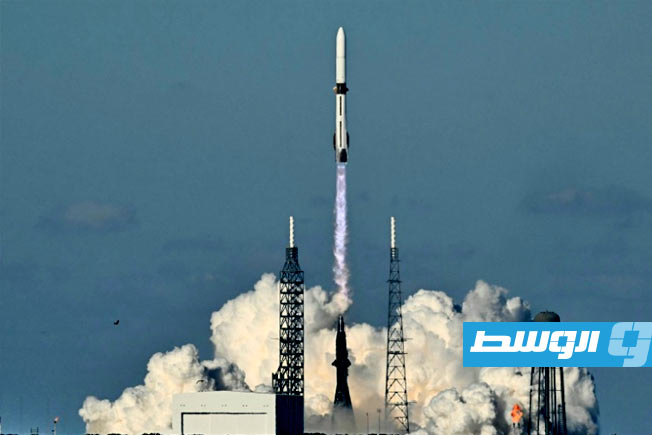
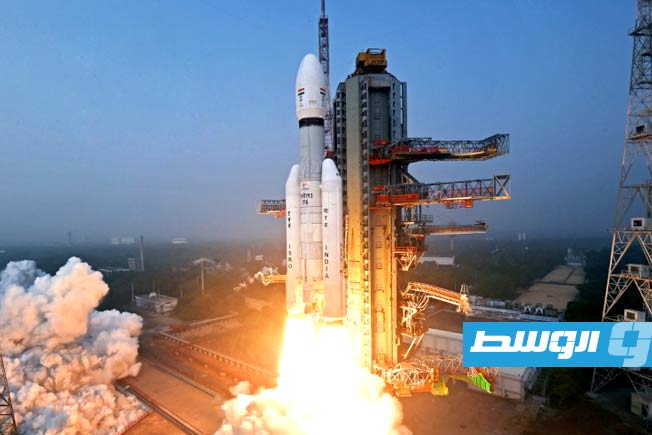
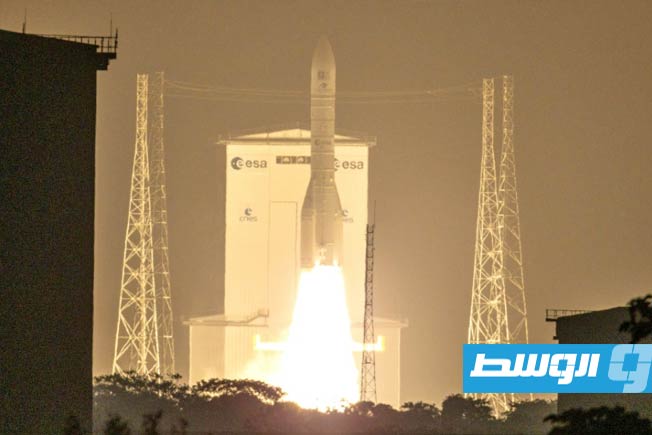
A report from the office of the President of Argentina stated that a small Argentine satellite will be launched into space coinciding with the upcoming “Artemis 2” lunar mission by NASA, scheduled for next February.
The report said, “During the launch operation, the small Argentine satellite ‘Athena’, belonging to the National Commission for Space Activities and developed in collaboration with the Argentine company ‘VENG’, will be deployed. The project also involved the Argentine Institute of Radio Astronomy, the National Atomic Energy Commission, the National University of La Plata, the National University of San Martín, and the Faculty of Engineering of the University of Buenos Aires.”
Measuring Radiation in Distant Orbits
It was clarified that the small satellite will be launched 70,000 kilometers from Earth, a record distance for Argentine satellites.
According to the report, “In space, the Athena satellite will measure radiation in distant orbits, test components for space applications, receive GPS data for geostationary transfer orbits, and test long-range communication channels.”
Argentina
Argentina is a South American nation with a rich cultural heritage shaped by indigenous traditions, Spanish colonization, and later waves of European immigration. Its history includes declaring independence from Spain in 1816 and periods of significant economic growth, political upheaval, and the development of globally influential cultural elements like tango music and cuisine.
NASA
NASA, or the National Aeronautics and Space Administration, is the United States government agency responsible for the civilian space program, established in 1958 in response to the Soviet Union’s early space achievements. It is renowned for the Apollo Moon landing missions, the Space Shuttle program, and its ongoing research and exploration efforts through the International Space Station and robotic spacecraft.
Artemis 2
Artemis 2 is NASA’s first crewed mission of the Orion spacecraft, scheduled to launch no earlier than September 2025. It is a key step in the Artemis program, which aims to return humans to the Moon and establish a sustainable presence, with this mission involving a lunar flyby to test systems with astronauts aboard.
Athena
Athena is the ancient Greek goddess of wisdom, warfare, and crafts, often associated with the city of Athens, which is named in her honor. Her most famous cultural site is the Parthenon, a temple dedicated to her on the Acropolis of Athens, constructed in the 5th century BCE during the height of Athenian power.
National Commission for Space Activities
The National Commission for Space Activities (CONAE) is Argentina’s civilian space agency, founded in 1991 to replace the previous National Space Research Commission. It is responsible for the country’s space policy, satellite development, and the operation of its satellite missions, such as the SAC series, for Earth observation and scientific purposes.
VENG
VENG is an ancient city located in present-day Laos, serving as the capital of the Lan Xang Hom Khao (“Land of a Million Elephants and the White Parasol”) kingdom from 1354 to 1560. Founded by King Fa Ngum, it was a major political and Buddhist religious center before the capital was moved to Luang Prabang. Today, its ruins near the modern town of Muang Vieng Kham are a UNESCO World Heritage Site.
Argentine Institute of Radio Astronomy
The Argentine Institute of Radio Astronomy (IAR) is a scientific research institute founded in 1962, located near the city of La Plata. It was established through an agreement between Argentina’s National Scientific and Technical Research Council (CONICET) and the University of La Plata, with its original twin 30-meter radio telescopes becoming operational in 1966. The institute is dedicated to the study of the universe through radio waves, with a historical focus on research areas such as interstellar medium and pulsars.
National Atomic Energy Commission
The National Atomic Energy Commission (CNEA) is Argentina’s state agency responsible for nuclear research and development, founded in 1950. It oversees the country’s nuclear program, including power generation, radioisotope production, and scientific research, playing a key role in establishing Argentina as a leader in Latin American nuclear technology.
National University of La Plata
The National University of La Plata (UNLP) is a major public university in Argentina, founded in 1905 by Dr. Joaquín V. González with a strong emphasis on positivist and scientific principles. It is renowned for its iconic natural history museum, the Museo de La Plata, and its historically progressive and free tuition model.
National University of San Martín
The National University of San Martín (UNSAM) is a public university in Argentina, founded in 1992 in the province of Buenos Aires. It was established to promote advanced scientific research and higher education, quickly gaining recognition for its focus on science, technology, and the arts.
Faculty of Engineering of the University of Buenos Aires
The Faculty of Engineering of the University of Buenos Aires (FIUBA) was formally established in 1952, though its origins trace back to engineering departments within the university from the late 19th century. It is one of Argentina’s most prestigious engineering schools, located in the Buenos Aires neighborhood of Las Naciones, and is renowned for its significant contributions to the country’s technological and industrial development.
Earth
Earth is the third planet from the Sun and the only known astronomical object to harbor life. Its geological history spans over 4.5 billion years, with the evolution of life beginning at least 3.7 billion years ago, leading to the diverse biosphere and human civilizations of today.
GPS
GPS, or the Global Positioning System, is a satellite-based navigation system developed and operated by the United States Department of Defense, with its first satellite launched in 1978. It became fully operational in 1995, providing precise location and timing information globally for both military and civilian use.