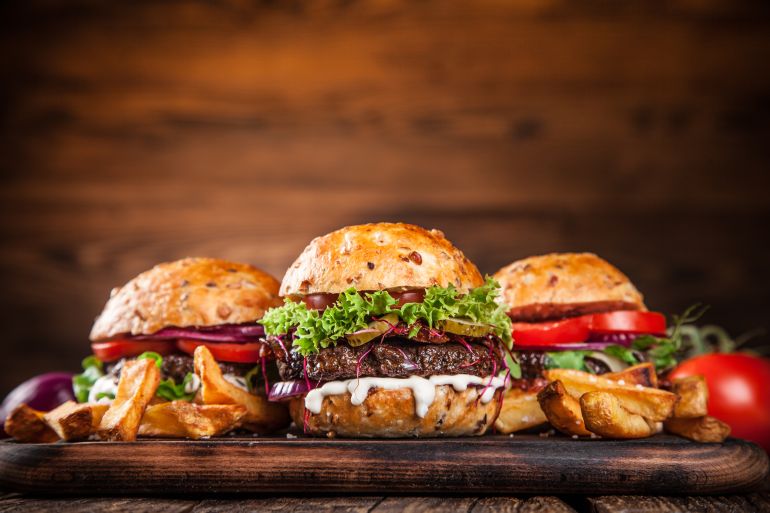
Given the widespread availability of fast food and commercial restaurants, a burger is not always what it appears to be in advertising images. Behind the appetizing look and salty taste, there may be patties that are not made entirely of pure beef, but instead contain fillers or artificial additives aimed at reducing cost or improving texture and flavor.
According to nutrition experts, it is possible to detect these differences by observing a set of clear signs during purchase, cooking, or consumption.
1. Absence of the phrase “100% beef”
The first and clearest sign is the lack of an explicit mention of the phrase “100% beef” on the menu or the restaurant’s website. Restaurants that use pure meat typically advertise this fact, while others use generic terms like “grilled patty” or “seasoned beef,” which may hide the presence of additives or mixed meats.
2. Long and unfamiliar ingredient list
A real beef patty should contain only beef, and perhaps salt and pepper. The presence of a long list of ingredients is an indicator of industrial processing. Some of the most suspicious ingredients include:
Soy protein or textured vegetable protein (TVP).
Modified food starch
Maltodextrin
Carrageenan
Sodium phosphate
Natural flavors
3. Rubbery or spongy texture
Natural ground beef has a noticeable variation in tissue and fat content, while fillers give a homogeneous, elastic texture similar to sausage. A “springy” sensation when chewing, instead of natural crumbling, often indicates the presence of industrial binders.
Real beef crumbles naturally when chewed, while processed patties tend to maintain their shape and exhibit excessive cohesion.
4. Excessive shrinkage and water release during cooking
Significant shrinkage of the burger patty, or noticeable release of liquids during cooking, may indicate added water. Real beef shrinks primarily due to fat melting, not water loss, which is an important distinction when assessing meat quality.
5. Weak meat flavor with high saltiness
The true flavor of beef is rich and distinct. A burger dominated by a salty taste without a meaty flavor is usually mixed with fillers, compensating for the natural flavor with increased sodium.
High levels of sodium and preservatives may cause noticeable thirst after eating, which is less common with pure beef.
6. Gray or uniform internal color
According to nutrition experts, real beef cooks with natural color gradations. In heavily processed patties, the interior may appear a uniform gray color or have a smooth, pasty texture, indicating intensive industrial manufacturing.
7. Unnatural aftertaste that lingers after eating
A strange taste that persists after finishing the burger may be due to flavor enhancers, phosphates, or hydrogenated proteins, which are common in processed meats.
8. Unnatural smell during cooking
Real beef has a distinct smell when cooked. If you notice a smell resembling sausages, processed meat, or a faint chemical odor, it may indicate the presence of additives or processed proteins.
9. Quick burning on the outside while the inside remains undercooked
A burger containing sugars or fillers may brown or burn quickly while the inside remains undercooked, due to additives that react with heat.
10. Identical cooking results every time
If the burger’s shape, texture, and taste are exactly the same every time, this points to highly processed industrial manufacturing, not freshly ground meat.
burger
“Burger” likely refers to the Hamburger Dom, a large public festival and fair held in Hamburg, Germany. Originating in the 11th century as a market accompanying the consecration of the city’s cathedral, it has evolved into one of Germany’s oldest and largest funfairs, held three times a year. The name “Dom” itself comes from the original cathedral (Dom) site where the event was first established.
fast food
Fast food refers to a style of mass-produced, quickly served cuisine that became a global cultural phenomenon in the 20th century, largely popularized by American chains like McDonald’s, which originated in the 1940s. Its history is tied to post-war car culture, standardization, and the rise of consumer convenience, leading to widespread influence on diets, urban landscapes, and economies worldwide.
commercial restaurants
Commercial restaurants, as establishments serving prepared meals for profit, emerged in ancient civilizations like Rome and China but became widespread in Europe during the 18th century with the rise of urbanization. The modern restaurant concept, offering individual tables and a menu of choices, is often traced to Paris in the late 1700s following the French Revolution. This model rapidly globalized, evolving into the diverse dining industry seen today.
beef
“Beef” is not a place or cultural site, but a culinary term for meat from cattle. Historically, beef has played a significant role in various food cultures, such as in Argentine asado, American barbecue, and Japanese Kobe beef traditions, often tied to agricultural practices and regional identities.
paper
Paper is a versatile material traditionally made from plant fibers, with its invention in ancient China around the 2nd century BCE revolutionizing communication and record-keeping. Its production method spread globally, becoming fundamental to the development of writing, art, and culture.
meat
“Meat” is not a specific place or cultural site, but a general food category. Historically, the hunting, domestication, and processing of animal meat has been a central part of human cultural development and subsistence across all societies. Different cultures have developed unique culinary traditions, preservation methods, and rituals surrounding its preparation and consumption.
seasoning
“Seasoning” typically refers to the process of adding herbs, spices, or other flavorings to food. Historically, the use of seasoning dates back thousands of years, with ancient civilizations trading spices like salt, pepper, and cinnamon for both culinary and preservation purposes. This practice has profoundly shaped global trade routes, cultural cuisines, and food preservation techniques throughout history.
herbs
Herbs refer to plants valued for their culinary, medicinal, or aromatic properties, with their use dating back to ancient civilizations like Egypt, China, and Greece for both food and healing. This cultural practice of cultivating and utilizing herbs has evolved over millennia, deeply influencing global cuisines, traditional medicine systems, and gardening traditions.
vegetables
“Vegetables” is not a specific place or cultural site, but a general category of edible plants. Historically, the cultivation of vegetables began with the dawn of agriculture over 10,000 years ago, playing a crucial role in the development of human settlements and diets across all cultures.
sausages
Sausages are a type of prepared meat product with a history dating back to ancient civilizations like Sumeria and Rome, where they were created as a method to preserve and utilize all parts of the animal. Today, they are a significant element of culinary culture worldwide, with countless regional varieties such as German bratwurst, Spanish chorizo, and Italian salsiccia.
processed meat
“Processed meat” is not a specific place or cultural site, but a category of food. Historically, the practice of curing, smoking, and preserving meats like ham, bacon, and sausages dates back thousands of years as a crucial method for preventing spoilage before modern refrigeration. This culinary tradition is deeply embedded in many cultures worldwide, with specific regional varieties such as Spanish jamón, Italian salami, and German bratwurst becoming iconic cultural products.
menu
The menu, as a printed or digital list of food and drink offerings at a restaurant, has its origins in 18th-century France. It evolved from a single large board into individual cards, becoming a standard tool for customer choice and a reflection of a restaurant’s culinary identity and pricing.
restaurant’s website
This is a restaurant’s website, which is a digital platform for a dining establishment to showcase its menu, location, and services. Its history is typically tied to the founding of the restaurant itself, detailing when it opened and its culinary philosophy.
grilled patty
“Grilled patty” is not a specific place or cultural site, but a food item. It is a culinary concept with a broad history, often associated with the hamburger, which has origins in 19th-century Germany and was popularized in the United States. The grilled ground meat patty is now a global food staple found in countless variations.
soy protein
Soy protein is not a place or cultural site, but a food ingredient derived from soybeans. Its history as a staple food source dates back thousands of years in East Asia, with modern industrial extraction methods developed in the 20th century to create concentrated protein products.
textured vegetable protein
Textured vegetable protein (TVP) is a versatile, shelf-stable food product made from defatted soy flour, often used as a meat substitute. It was developed and became widely available in the 1960s as an inexpensive, high-protein food source. Its creation is closely tied to the mid-20th century growth of the soy processing industry.
TVP
TVP is Poland’s national public broadcasting service, founded in 1952 during the communist era as a state-controlled media outlet. Following Poland’s transition to democracy in 1989, it was transformed into a public broadcaster, though it has frequently faced criticism and political controversy over allegations of government influence and bias in its reporting.
modified food starch
Modified food starch is a processed carbohydrate derived from sources like corn, wheat, or potatoes, used as a thickening or stabilizing agent in many food products. Its history is tied to 20th-century industrial food science, which developed methods to modify native starches for improved texture, shelf stability, and performance under various cooking conditions. This ingredient is now ubiquitous in packaged foods, from sauces to baked goods.
maltodextrin
Maltodextrin is not a place or cultural site; it is a carbohydrate derived from starch, commonly used as a food additive. Its history is tied to industrial food processing, developed to provide a stable, easily digestible thickener and sweetener in products.
carrageenan
Carrageenan is not a place or cultural site, but a natural substance extracted from red seaweed, historically harvested for centuries in coastal communities like Ireland and the Philippines. It has been used traditionally as a food thickener and stabilizer, and its commercial extraction and use expanded significantly in the 20th century.
sodium phosphate
Sodium phosphate is not a place or cultural site, but a chemical compound commonly used in food processing, cleaning products, and medicine. It has no historical narrative as a location, though its industrial and scientific applications have developed over the past century.
natural flavors
“Natural flavors” is not a specific place or cultural site, but a term used in food labeling to describe flavoring substances derived from plant or animal sources. The concept has a long history tied to the use of herbs, spices, and extracts in cooking, but its modern regulatory definition emerged in the 20th century with food labeling laws.
ground beef
“Ground beef” is not a place or cultural site; it is a common food ingredient made from finely chopped beef. Historically, its origins are tied to the broader practice of grinding meat, which dates back centuries and became more widespread with the advent of mechanical meat grinders in the 19th century.
sausage
Sausage is a type of prepared meat product with a history dating back to ancient civilizations like Sumeria and China, where it was developed as a method to preserve and utilize meat. It has since evolved into a vast array of regional varieties worldwide, becoming a central element in many cultural cuisines and food traditions.
water
Water is a fundamental natural resource essential to all life on Earth, covering about 71% of the planet’s surface. Historically, it has been central to the development of human civilization, serving as a source of sustenance, a means of transportation, and a focal point for settlement and cultural practices. Many ancient societies, such as those in Mesopotamia and the Indus Valley, arose along major rivers due to the fertile land and access to water.
fat
“Fat” is not a recognized place or cultural site. It may be a misspelling or shorthand for a location such as Fátima, Portugal, a major Catholic pilgrimage site. The Sanctuary of Fátima commemorates the 1917 Marian apparitions reported by three shepherd children.
sodium
Sodium is not a place or cultural site; it is a chemical element (symbol Na, atomic number 11). Historically, it has been isolated and used in various compounds, but it does not have a cultural or historical location to summarize.
preservatives
“Preservatives” are not a place or cultural site, but substances used to inhibit spoilage in food, cosmetics, and other products. Their history dates to ancient methods like salting and smoking, with modern chemical preservatives being developed significantly during the 19th and 20th centuries to extend shelf life and ensure safety.
phosphates
Phosphates are not a specific place or cultural site, but a class of mineral compounds crucial for agriculture and industry. Historically, large-scale mining of phosphate rock began in the mid-19th century, with major deposits exploited in places like Florida, Morocco, and the Pacific island of Nauru, profoundly impacting those local economies and environments.
hydrogenated proteins
“Hydrogenated proteins” is not a specific place or cultural site, but a food science term referring to proteins that have undergone a chemical process called hydrogenation to alter their structure and functionality. This process is historically significant in food manufacturing for creating ingredients like textured vegetable protein, which emerged as a cost-effective meat alternative and protein supplement in the mid-20th century.
processed meats
Processed meats refer to meats that have been preserved through methods such as salting, curing, fermentation, or smoking, with historical roots tracing back to ancient civilizations seeking ways to store food without refrigeration. This category includes items like sausages, bacon, and ham, which have become integral to various global cuisines and food traditions.
processed proteins
“Processed proteins” is not a specific place or cultural site, but a general term for food products like sausages, jerky, or protein powders. Historically, methods such as salting, smoking, and curing were developed to preserve meat and other protein sources long before modern industrial processing.
sugars
“Sugars” is not a recognized place or cultural site. It is a common term for sweet-tasting carbohydrates, such as sucrose, found in many foods. There is no specific historical or cultural location associated with the word itself.