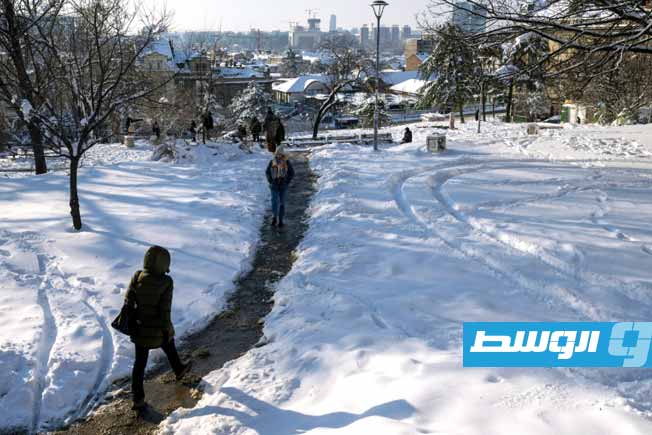
Serbian police charged six people on Thursday in connection with a pro-government singer being pelted with snowballs during a New Year’s celebration concert.
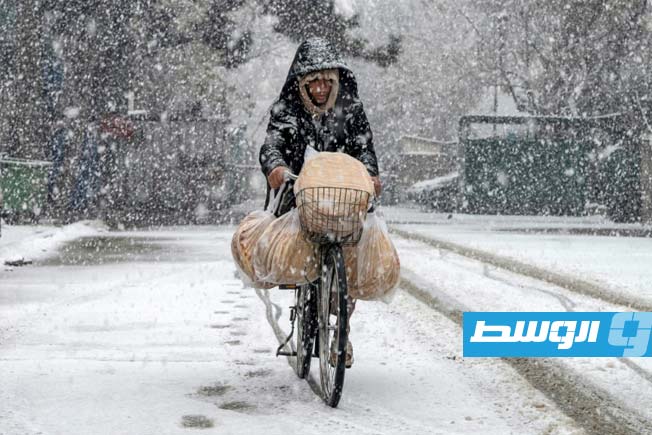
Police stated that the accused threw “frozen snowballs” at singer Ana Bekuta, who was the partner of a late high-ranking political official, and at her band during a concert held on Tuesday evening in the city of Čačak, located about 100 kilometers south of the capital Belgrade.
Videos circulating online showed snowballs flying from the audience towards the stage, hitting the singer and musicians amid jeers. According to local media, Bekuta was forced to end the concert early and take shelter inside a small bus.
The 66-year-old singer was in a relationship with the late Milutin Mrkonjić, a prominent figure in the party of former leader Slobodan Milošević.
Protest organizers stated via Instagram: “A pointless concert is being held, spending our money to celebrate the New Year (according to the Orthodox calendar), costing us all 40,000 euros.”
– A Dutch court rules a marriage conducted by ‘Chat GPT’ invalid
– Jewellery worth one million euros stolen from American designer’s home in southern France
– Hackers postpone ‘ransom’ deadline after breaching medical records of thousands of New Zealanders
In response, President Aleksandar Vučić, who has faced a protest movement for over a year, told state television that what happened in Čačak “is a warning to Serbian citizens about what [his opponents] will do if they come to power.”
Conversely, activist Slavica Petrovska commented, questioning: “Should snowball fights be a criminal offense? Impossible. I think they are just trying to intimidate other cities so they don’t follow the example of the people of Čačak.”
Serbia
Serbia is a country in Southeast Europe with a rich history that includes being the core of several medieval kingdoms and later a major part of Yugoslavia. Its cultural sites, such as the medieval monasteries of Studenica and Sopoćani (UNESCO World Heritage Sites), reflect its deep Orthodox Christian heritage and artistic traditions. The capital, Belgrade, is one of Europe’s oldest continuously inhabited cities, with a fortress overlooking the confluence of the Danube and Sava rivers.
Čačak
Čačak is a city in western Serbia, historically significant for its role during the First Serbian Uprising against Ottoman rule in the early 19th century. It is known for cultural sites like the Church of the Ascension and the National Museum, which highlight its heritage. The surrounding Ovčar-Kablar Gorge area is also famed for its natural beauty and historical monasteries.
Belgrade
Belgrade is the capital of Serbia, situated at the strategic confluence of the Danube and Sava rivers. Its history is marked by frequent conflict and conquest, having been fought over by the Roman, Byzantine, Ottoman, and Austro-Hungarian empires, which is reflected in its varied architecture. The city’s iconic Kalemegdan Fortress stands as a testament to its long and turbulent past.
New Zealand
New Zealand is an island country in the southwestern Pacific Ocean, first settled by the Māori people around 1300 AD and later colonized by the British, leading to the signing of the Treaty of Waitangi in 1840. It is known for its dramatic natural landscapes, unique biodiversity, and a modern culture that blends Māori and British colonial heritage.
southern France
Southern France is a diverse region historically shaped by Roman settlement, medieval conflicts like the Albigensian Crusade, and its role as a center of Occitan culture. It is renowned for landmarks such as the Roman Pont du Gard aqueduct, the medieval fortified city of Carcassonne, and the papal palace in Avignon. The area’s distinct identity is also reflected in its Provençal language, cuisine, and traditions.
Dutch
The Netherlands, often referred to as Holland, is a country in Northwestern Europe with a rich history as a major maritime and trading power during the 17th-century Dutch Golden Age. Its culture is famously associated with windmills, tulip fields, cycling, and artistic masters like Rembrandt and Van Gogh.
Instagram
Instagram is a social media platform founded in 2010, initially focused on sharing photos and videos with artistic filters. It has since evolved into a major cultural site for visual communication, influencer marketing, and global trends, significantly impacting digital culture and social interaction.
Orthodox calendar
The Orthodox calendar, also known as the Julian calendar, is a traditional system for calculating liturgical dates and feast days used by many Eastern Orthodox Churches. It was established by Julius Caesar in 45 BC and remains in use today, running 13 days behind the modern Gregorian calendar for fixed celebrations like Christmas. Its history is central to maintaining the continuity of Orthodox liturgical tradition and ecclesiastical independence.
state television
State television refers to television broadcasting services that are operated, funded, or controlled by a national government. Historically, such broadcasters were often established to serve as official mouthpieces for state propaganda, news, and cultural programming, particularly in authoritarian regimes or during eras of limited media plurality. While some state broadcasters have evolved into public service models with editorial independence, others remain closely aligned with government perspectives.