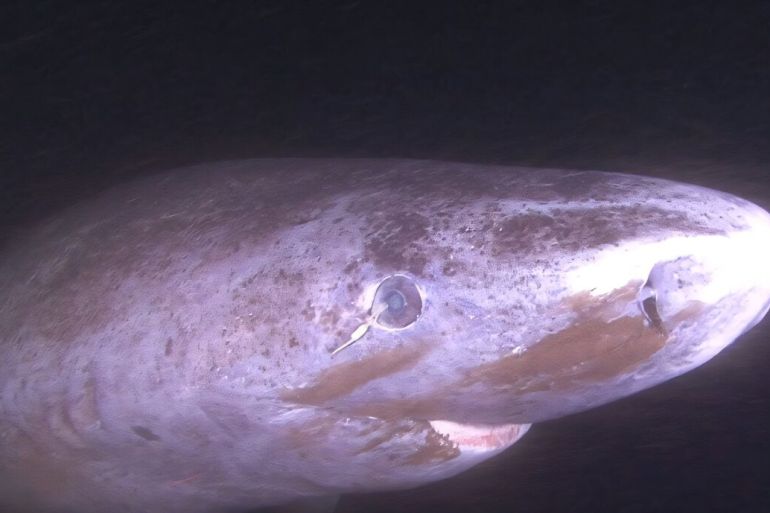
In the cold polar depths, where light is exceedingly rare, the Greenland shark lives a life that is almost outside the normal pattern for other vertebrates. This shark can live for centuries, potentially reaching up to 400 years old.
Based on this, there was a long-held belief among researchers for many years that it does not see well as it ages, especially since examinations of its eyes often show the presence of a parasite attached to the cornea, appearing like a curtain that clouds vision.
A Different Kind of Eye
However, new research from the University of California, Irvine suggests the picture is more complex and stranger. The eye is not a worn-out organ barely functioning, but rather an optical system adapted to darkness, and it appears to retain its integrity even in individuals over a hundred years old.
The study was published in the journal “Nature Communications.” In it, the researchers relied on evidence from multiple levels to reach these conclusions. For example, they began with detailed microscopic examinations of retinal tissue, then conducted analyses of genes responsible for the eye, and tested for cell death indicators.
The team found that the fundamental layers of the retina were remarkably intact, showing no clear signs of degeneration, as one might assume in such a sensitive tissue that has lived for such a long time.
Vision in the Dark
On the other hand, the retina in many animals, including humans, is one of the tissues most quickly burdened by age, showing stress, inflammation, and cell damage relatively easily.
Scientists believe the reason is related to the sharks’ adaptation to this dark environment, where seeing colors and fine details is not a priority, but rather the ability to capture the smallest possible amount of light.
Therefore, the results point to a heavy reliance on rod cells in the eyes, which are responsible for vision in low light, with a significant decline in the use of cone cells, which provide us with color vision and detail acuity in bright light.
According to the study, this means the shark does not need a complex visual system that constantly chases colors and fine details. The less complexity, the fewer areas that can fail with age.
A Maintenance System
In addition, scientists believe this shark possesses an internal maintenance system stronger than usual, related to repairing DNA damage.
When cells live for a long time, the real challenge is to prevent the accumulation of small errors in the DNA, which over decades turn into major damage.
The study adds another level related to retinal lipids. The membranes of nerve cells in that region are not just walls surrounding the cell, but an environment upon which the vision proteins themselves operate.
The study points to a lipid composition that may support the performance of these proteins under harsh conditions, as if the cell membrane has been prepared to maintain the readiness of the vision tools for many years, instead of stiffening or malfunctioning over time.