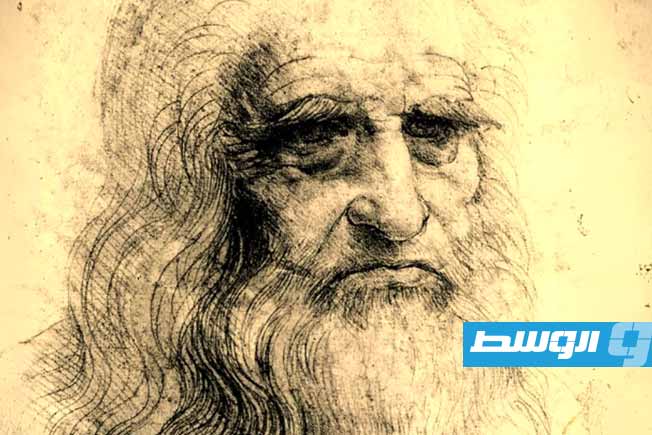
Scientists involved in the “Leonardo da Vinci DNA Project” have announced their success in extracting potential samples of the genetic material of the famous artist and inventor, a step described as surpassing the “threshold of impossibility” in the field of tracing historical figures.
These results came in a preliminary study that revealed the ability of modern techniques to extract rich biological material from objects previously thought to be “biologically silent,” such as wax seals on old letters and absorbent paper layers, according to a study published in the journal “Biological Archive.”
The research team explained that the innovative technique is not limited to humans; it can also pull samples of plant, bacterial, fungal, and viral traces from artifacts.
In a precise experiment, researchers scanned a chalk drawing suspected to be a work by da Vinci known as “The Holy Child,” succeeding through next-generation sequencing in extracting biological information that included traces of orange trees that were grown in the Medici gardens in Tuscany, in addition to human DNA bearing markers of the Y chromosome.
Although the identity of the owner of this DNA has not yet been determined, genetic indicators point to a male belonging to a lineage common in the Mediterranean region, specifically central and southern Italy, the region from which da Vinci originated.
By comparing these samples with swabs taken from a 500-year-old letter belonging to a relative of the artist, researchers found a “shared Y chromosome signal,” a signal that was completely absent when examining paintings by other European artists from the same period, strengthening the hypothesis of accessing da Vinci’s true lineage.
Success has become “inevitable”
The project ultimately aims to reconstruct da Vinci’s complete genome and confirm his final burial place, as historical doubts are raised about whether the remains in a small church in the Loire Valley in France truly belong to him. To this end, researchers are currently working on tracing da Vinci’s family tree, which has roots dating back to 1331, and have already succeeded in identifying a number of living descendants to match their genetic results.
It is believed that success has become “inevitable” after overcoming this technical challenge, noting that these pioneering methods will open the door to understanding the depths of other major historical figures. Although the study still offers “threads and not final conclusions,” independent experts have expressed admiration for the systematic steps taken, confirming that the project has succeeded in building a solid “reference framework” for detecting genetic signatures in ancient artworks and documents.
Leonardo da Vinci DNA Project
The Leonardo da Vinci DNA Project is an international research initiative aimed at verifying and studying the remains believed to be those of the Renaissance master, as well as analyzing traces of his DNA from artworks and personal artifacts. Its goal is to gain deeper insights into his ancestry, health, and physical characteristics by examining genetic material from his descendants and potential relics.
Biological Archive
The Biological Archive is a specialized repository dedicated to preserving and cataloging biological specimens, such as genetic material, tissues, and seeds, for scientific research and conservation. Its history is rooted in the late 20th and early 21st centuries, emerging from global efforts to combat biodiversity loss and create genetic backups of endangered species. These archives serve as vital resources for studying evolution, disease, and ecological change.
The Holy Child
The Holy Child is a revered religious icon, often referring to statues or images of the infant Jesus, particularly the Santo Niño de Cebú in the Philippines. This specific figure was presented by Ferdinand Magellan in 1521 as a gift upon the baptism of Rajah Humabon and his wife, symbolizing the introduction of Christianity to the archipelago. It remains a central object of devotion and is celebrated annually in the vibrant Sinulog Festival.
Medici gardens
The Medici gardens refer to several Renaissance gardens in Tuscany, Italy, commissioned by the powerful Medici family starting in the 15th century. Most notably, the Boboli Gardens in Florence were created as a grand example of Italianate garden design, showcasing the family’s wealth, artistic patronage, and control over nature. These gardens are now UNESCO World Heritage sites, recognized for their influence on European landscape architecture.
Tuscany
Tuscany is a region in central Italy renowned for its picturesque landscapes, historic art cities like Florence and Siena, and its profound influence on the Renaissance during the 14th–17th centuries. Its history is deeply intertwined with the Etruscan civilization, the medieval power of city-states, and its role as the birthplace of iconic figures such as Dante and Leonardo da Vinci.
Mediterranean region
The Mediterranean region is a historical and cultural area surrounding the Mediterranean Sea, known as the cradle of several ancient civilizations including the Egyptians, Greeks, Romans, and Phoenicians. Its history is deeply marked by trade, cultural exchange, and conflict, which shaped the foundations of Western and Middle Eastern societies. Today, it remains a vibrant and diverse region defined by a shared climate, cuisine, and a complex, interconnected past.
Italy
Italy is a country in Southern Europe with a rich cultural history that dates back to the ancient Roman Empire, which was a foundational civilization for Western law, government, and engineering. It later became the epicenter of the Renaissance, a period of immense artistic and scientific flourishing, and today is renowned for its historic cities, artistic masterpieces, and culinary traditions.
Libya
Libya is a North African country with a rich history rooted in ancient civilizations like the Phoenicians and Romans, followed by centuries of Arab and Ottoman influence. In the modern era, it was an Italian colony before gaining independence in 1951, later becoming known for Muammar Gaddafi’s lengthy rule from 1969 until the 2011 revolution. The country is home to UNESCO World Heritage sites, such as the ancient Greek city of Cyrene and the Roman ruins of Leptis Magna.
Loire Valley
The Loire Valley in central France is a UNESCO World Heritage site renowned for its historic towns, vineyards, and over 300 châteaux built or extensively rebuilt during the French Renaissance. Its architectural heritage is largely a result of the French royalty and nobility establishing court in the region from the late 15th through the 17th centuries. This period transformed the valley into a center of culture and political power, leaving a landscape often called the “Garden of France.”
France
France is a Western European nation with a rich history shaped by Celtic, Roman, and Frankish influences, evolving from a monarchy into a leading republic. It is globally renowned for its cultural landmarks like the Eiffel Tower and Louvre Museum, as well as its profound impact on art, philosophy, and cuisine.