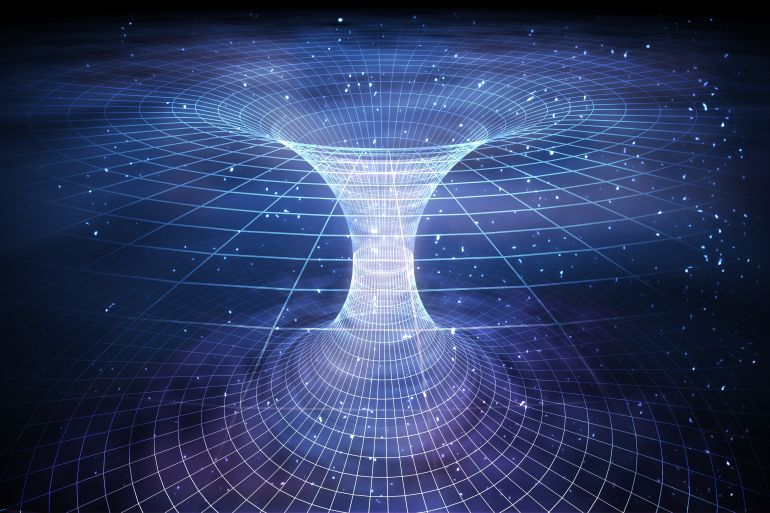
If you were to follow a beam of light passing near a massive star, you might see something strange: this beam would bend as it passes above the star, as if the star were a magnet attracting it. Light does not bend because something is pulling it, but because “spacetime” itself is curved, causing light rays to travel along curved paths.
This Einsteinian analogy has resurfaced, but in an unexpected place: electronic chips. Researchers have discovered that electrons can be influenced by a hidden geometry in quantum space, making their paths appear to curve in a way metaphorically similar to the bending of light by gravity.
The above is not an attempt to actually link the electron to gravity, but a story about a new type of geometry in condensed matter physics, which studies the properties of matter in its solid and liquid states, and how these properties arise from the interaction of atoms with each other according to the laws of quantum mechanics.
A team has successfully observed a clear experimental effect of this concept (quantum geometry) in a known material and published the results in the prestigious journal “Science”.

The Geometry of Materials
Future technologies, such as ultra-fast computing, rely on materials that behave according to quantum rules, not classical intuition.
Quantum mechanics is the theory that describes the behavior of very small particles like electrons and photons. It does not treat them as balls with a definite path, but as a system with a set of probabilities for what can happen.
In this context, designing new, precise materials is like trying to drive a car in thick fog. We know our destination, but we cannot see all the fine details that control the movement of electrons within crystal lattices, the networks in which atoms are arranged.
In quantum mechanics, the electron has a law governing its behavior, called the “wave function”. When the conditions of the surrounding environment change, such as the electric or magnetic field or the arrangement of atoms, this function changes, and two quantum states differ from each other because of that.
This difference is what the concept of “quantum metric” captures. It is a way to measure the distance between quantum states and is part of a broader entity called the “quantum geometric tensor”.
Promising Applications
According to the study, the team did not see this geometry through a camera, but detected its effect by measuring the deviation of particles from their usual linear behavior under the influence of strong magnetic fields. It appeared that there is indeed a real quantum geometry.
Then comes the cleverest step: this metric can be translated into a measurable electrical effect. The researchers have already managed to measure and control it electrically.
This result is truly important because it expands the role of quantum geometry from mere interpretation to a design tool. Measuring this effect allows for more precise characterization of the properties of delicate electronic materials, offering a new way to understand and design quantum materials.
Exploiting this new geometry could open a wide path towards more precise and better electronics, in addition to a potential impact on understanding and developing superconductivity, and light-matter interactions.