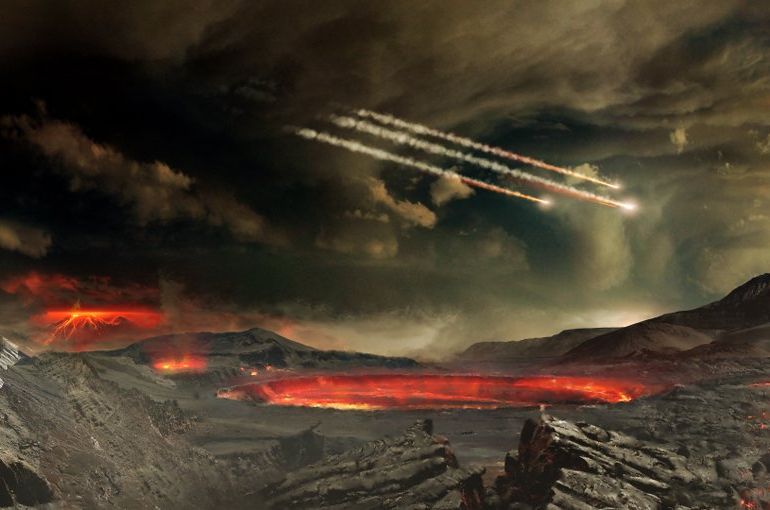
About 3.7 billion years ago, the Earth was completely different from what we know today. Its volcanoes were numerous and widespread, and its rocky crust formed and broke apart continuously.
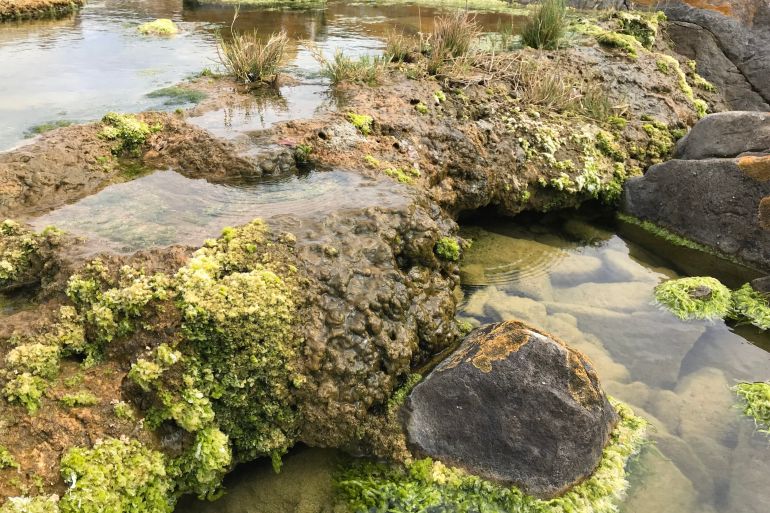
The problem scientists face when studying that period of the planet’s history is that rocks from that era are extremely rare. Therefore, every sample that has survived until today is a treasure preserving Earth’s infancy. This is precisely what made ancient rock pieces in the Murchison region of Western Australia a focus of scientific interest.
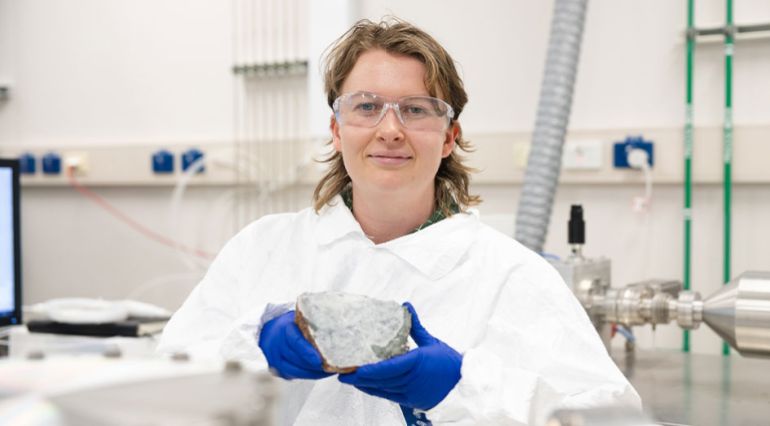
According to a new study published in the journal “Nature Communications,” scientists examined a type of igneous rock called “anorthosite,” which is among the oldest rocks in the world.
The work was led by researchers in collaboration with other research institutions. They focused specifically on studying small crystals within this type of rock called “plagioclase.”
These crystals can preserve a very precise chemical record of the environment in which they formed, especially if scientists can obtain parts unaffected by changes in later periods of Earth’s history.
The Secret of Strontium and Calcium
The team focused on isotopes of two key chemical elements: strontium and calcium. Isotopes are atoms of the same element, having the same number of protons in the nucleus, but differing from each other in mass and some other properties.
For the isotopes of these specific elements (strontium and calcium), they act like a precise clock, recording what happened at the time of their crystallization billions of years ago.
Scientists are particularly searching for what happened to our Earth’s mantle: Did it go through an early depletion phase or not? Depletion here means the mantle lost part of its components capable of forming magma, which are molten rocks beneath the Earth’s surface that move and feed volcanoes. In that distant past, these rocks were responsible for building continental crust, meaning that “depletion” is an indicator of when the construction of large continents in the geological sense began.
The primary result was surprising. The data obtained by scientists indicated that the growth of the first continents from that magma began about 3.5 billion years ago, roughly a billion years after our planet formed.
This does not mean that no crust existed before that; perhaps it did. However, the study specifically discusses the building of large, stable continents during that period, which differs from what geologists previously believed.
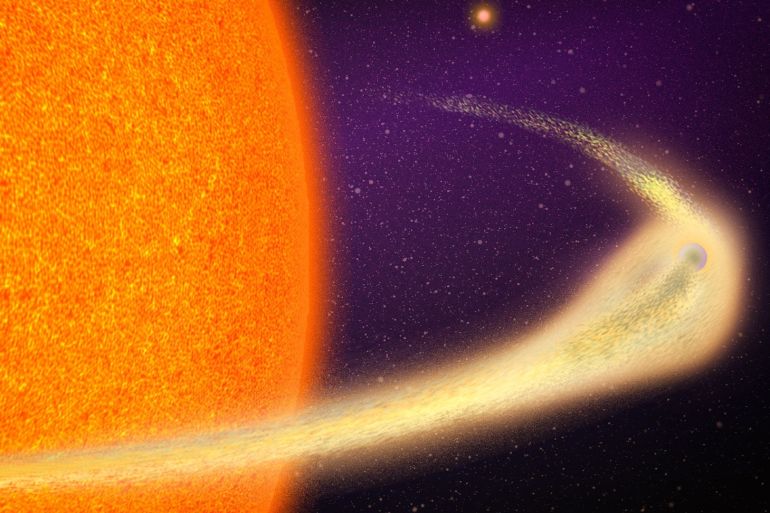
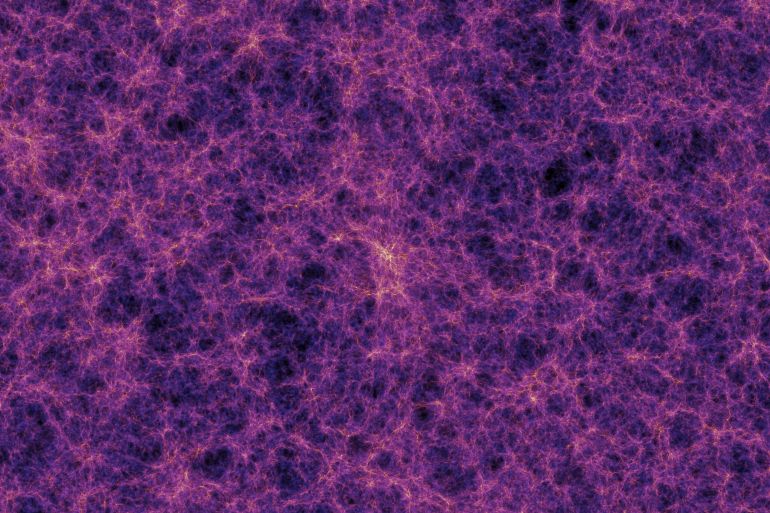
This readjusts scientists’ models of early Earth history (NASA)
What the Moon Brought
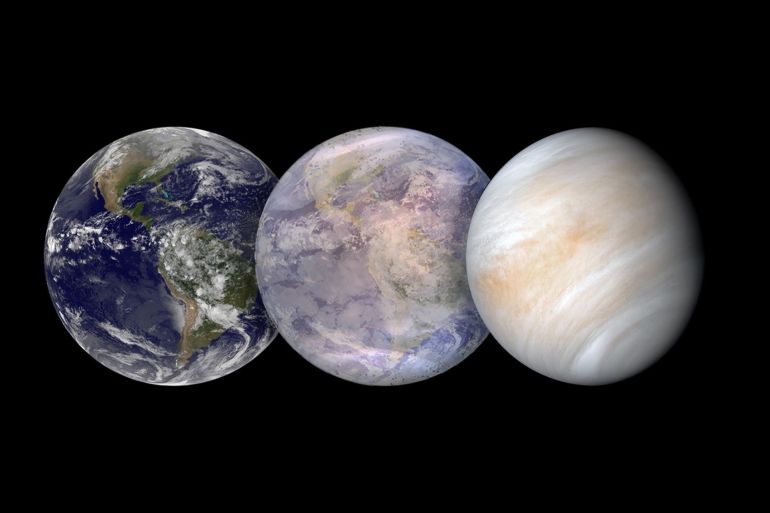
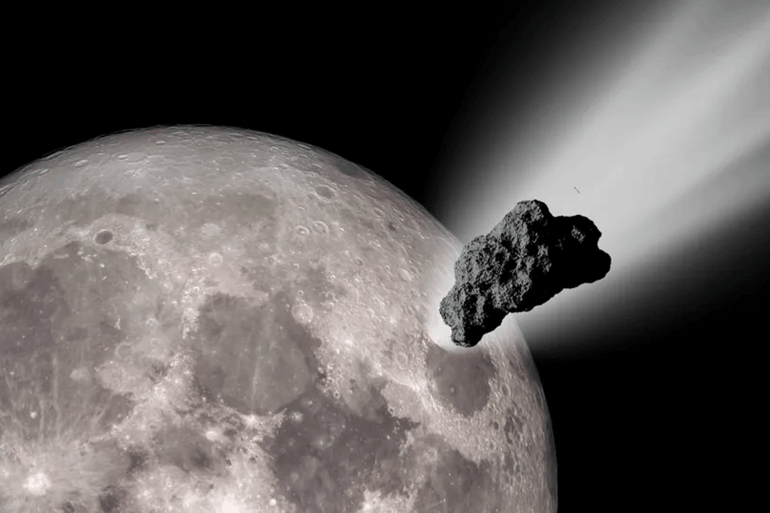
On the other hand, the team decided to compare their measurements with anorthosite rocks brought from the Moon during Apollo missions more than half a century ago. The comparison, according to the study, aligned with the hypothesis that Earth and the Moon had a similar initial composition about 4.5 billion years ago.</p
Earth
Earth is the third planet from the Sun and the only known astronomical object to harbor life, with a geological history spanning over 4.5 billion years. Its surface features diverse ecosystems and has been the cradle for the development of all known human cultures and civilizations.
Precambrian
The Precambrian is not a specific place or cultural site, but the informal name for the vast span of geological time from Earth’s formation about 4.6 billion years ago to the start of the Cambrian Period 541 million years ago. This supereon covers nearly 90% of Earth’s history and witnessed the formation of the planet, the first oceans, the emergence of life, and the buildup of oxygen in the atmosphere.
Murchison region
The Murchison region in Western Australia is a vast outback area historically significant for its major gold rushes in the late 19th century. It is home to important Indigenous cultural heritage and is now known for mining, pastoral stations, and the Murchison Radio-astronomy Observatory.
Western Australia
Western Australia is the largest state in Australia, covering the western third of the continent. Its modern history began with European exploration in the 17th century, followed by British settlement at the Swan River Colony (now Perth) in 1829, which was driven in part by the later discovery of significant gold deposits in the 1890s. The state is renowned for its vast, rugged landscapes, including the Kimberley region and numerous Aboriginal cultural sites that reflect a history stretching back tens of thousands of years.
Nature Communications
Nature Communications is a peer-reviewed, open-access scientific journal first launched in 2010, covering research across the natural sciences. It is part of the Nature Portfolio published by Springer Nature and was established to provide a multidisciplinary forum for significant advances in biology, physics, chemistry, and Earth sciences.
anorthosite
Anorthosite is a coarse-grained, intrusive igneous rock composed primarily of plagioclase feldspar. It is significant as the dominant rock type in the lunar highlands and is found in ancient geological formations on Earth, such as the Adirondack Mountains. Its history is tied to the early crustal formation of both the Moon and Earth, dating back billions of years.
plagioclase
Plagioclase is not a place or cultural site, but a series of important rock-forming minerals within the feldspar group. It is a major component of the Earth’s crust and is found in a wide variety of igneous and metamorphic rocks, such as basalt and granite. Its identification and study have been fundamental to geology, particularly in classifying rocks and understanding planetary formation.
strontium
Strontium is a chemical element, not a place or cultural site. It was discovered in 1790 by Adair Crawford in a mineral from a lead mine near Strontian, Scotland, from which it gets its name.
calcium
“Calcium” is not a place or cultural site, but a chemical element essential for living organisms. Historically, its compounds like limestone and gypsum have been used since antiquity in construction, such as in the pyramids of Egypt and classical Roman architecture.
Moon
The Moon is Earth’s only natural satellite, formed approximately 4.5 billion years ago from debris after a giant impact between Earth and a Mars-sized body. It has been a central object in human mythology, science, and exploration, most notably visited by humans during the Apollo program in the late 1960s and early 1970s.
Apollo missions
The Apollo missions were a series of NASA spaceflight programs in the 1960s and 1970s, most famously landing the first humans on the Moon with Apollo 11 in 1969. These missions represented a major achievement of the Cold War-era space race and greatly advanced scientific understanding of lunar geology.