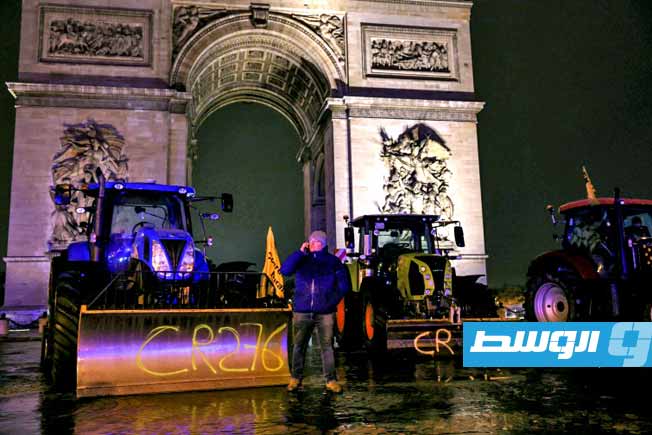
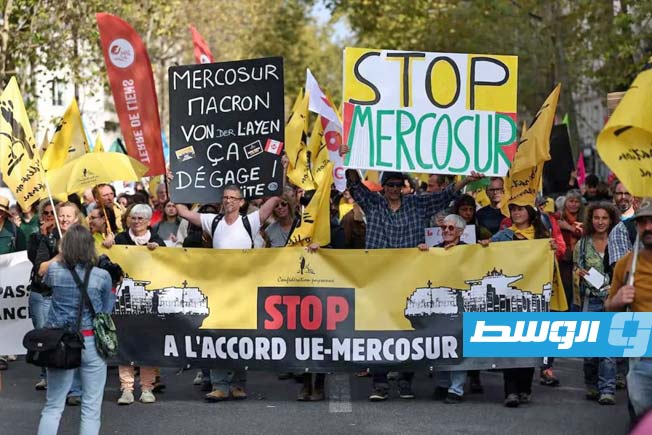
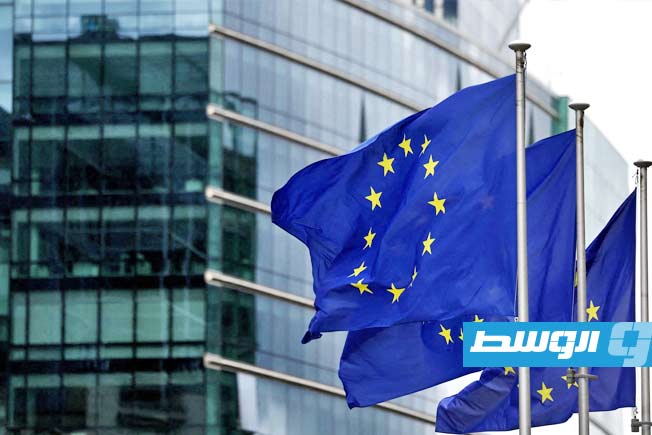
On Thursday, farmers entered Paris with their tractors, positioning them near the Eiffel Tower and the Arc de Triomphe, in protest against the impending signing of a trade agreement between the European Union and the Mercosur bloc (the South American Common Market).
It was stated that one hundred tractors entered the capital before dawn. The farmers are expected to protest on Thursday in front of the National Assembly building, with hopes of meeting the President of the National Assembly and the President of the Senate.
The agricultural sector is facing multiple crises, including an outbreak of lumpy skin disease in cattle, falling wheat prices, rising fertilizer costs, and the threat of increased competition should the European Union sign a free trade agreement that has been under negotiation for over 25 years with four South American countries: Argentina, Brazil, Uruguay, and Paraguay.
It was noted that ten tractors were parked close to the Eiffel Tower, with one tractor’s shovel bearing a slogan opposing the signing of the treaty. Another ten tractors were seen under the Arc de Triomphe, while security forces were heavily deployed. On the shovel of one tractor was written: “France! Do you still want your farmers?”
Since the winter of 2024, farmers have been demanding the simplification of administrative procedures and a relaxation of standards, particularly European ones, which they consider overly restrictive and a source of unfair competition with countries that have lower environmental requirements.
Eiffel Tower
The Eiffel Tower is an iron lattice tower in Paris, France, constructed as the centerpiece for the 1889 World’s Fair. Designed by Gustave Eiffel, it was initially criticized by some artists but became a global cultural icon and a symbol of France.
Arc de Triomphe
The Arc de Triomphe is a monumental triumphal arch in Paris, commissioned by Napoleon in 1806 to honor the French army. Completed in 1836, it stands at the western end of the Champs-Élysées and houses the Tomb of the Unknown Soldier from World War I beneath its vault.
Paris
Paris is the capital of France, historically founded as a Gallo-Roman settlement in the 3rd century BC on the Île de la Cité. It grew into a major European center of art, politics, and philosophy, famously symbolized by landmarks like the Notre-Dame Cathedral, the Louvre Museum, and the Eiffel Tower.
National Assembly building
The National Assembly building is the seat of South Korea’s legislative branch, located in Seoul. It was first established in 1948, with the current main building completed in 1975, symbolizing the nation’s modern democratic governance.
European Union
The European Union (EU) is a political and economic union of 27 European countries, founded to promote peace, stability, and economic cooperation after World War II. Its origins trace to the 1951 European Coal and Steel Community, which evolved through treaties into the modern EU with a single market and common policies.
Mercosur
Mercosur is a South American trade bloc established in 1991 by the Treaty of Asunción, with the founding members being Argentina, Brazil, Paraguay, and Uruguay. Its primary aim is to promote free trade and the fluid movement of goods, people, and currency among its member states. Over time, it has expanded to include associate members and has worked to foster political and economic cooperation across the region.
South American Common Market
The South American Common Market, known as Mercosur, is a regional economic and political bloc established in 1991 by the Treaty of Asunción. Its founding members—Argentina, Brazil, Paraguay, and Uruguay—aimed to promote free trade and the fluid movement of goods, people, and currency. Over time, it has expanded to include other nations and has evolved to address broader political and social cooperation among its members.
Argentina
Argentina is a South American nation with a rich cultural history shaped by indigenous peoples, Spanish colonization in the 16th century, and subsequent waves of European immigration. Its famous cultural sites include the cosmopolitan capital of Buenos Aires, the Perito Moreno Glacier in Patagonia, and the wine-producing region of Mendoza.
Brazil
Brazil is the largest country in South America, known for its vast Amazon rainforest and vibrant cultural exports like samba and football. Its modern history began with Portuguese colonization in 1500, leading to independence as an empire in 1822 and the establishment of a republic in 1889. Today, it is a diverse federal republic celebrated for its multicultural heritage and major cities like Rio de Janeiro and São Paulo.
Uruguay
Uruguay is a South American country known for its progressive social policies and stable democracy, having gained independence from Brazil in 1825 after earlier Spanish and Portuguese colonial rule. Its cultural identity is strongly shaped by gaucho (cowboy) traditions, the tango music and dance of the Río de la Plata region, and the historic quarter of Colonia del Sacramento, a UNESCO World Heritage site founded by the Portuguese in 1680.
Paraguay
Paraguay is a landlocked South American nation with a history deeply shaped by its indigenous Guarani heritage and Spanish colonization. It is known for cultural sites like the Jesuit Missions of La Santísima Trinidad de Paraná and Jesús de Tavarangue, which are UNESCO World Heritage ruins reflecting the region’s 17th-18th century Jesuit settlements. The country’s history also includes the devastating War of the Triple Alliance (1864-1870), which had a profound and lasting impact on its population and development.
France
France is a Western European nation with a rich history that dates back to ancient Gaul, later evolving through monarchy, revolution, and empire to become a modern republic. It is globally renowned for its influential art, philosophy, cuisine, and cultural landmarks like the Eiffel Tower and the Palace of Versailles.