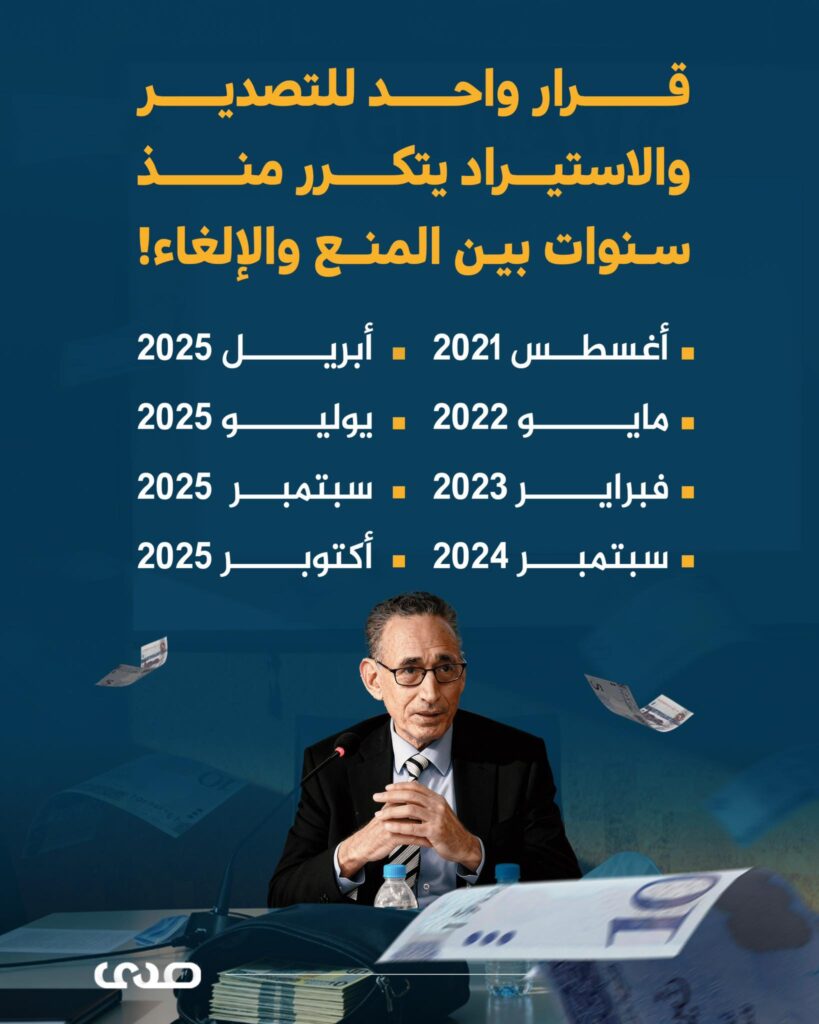
After backtracking on the decision to restrict import and export operations to banking channels, the official returns to announce the start of implementing what he called a “guiding import balance” in coordination with the central bank, to determine supply priorities.
However, the stark paradox is that these measures were only invoked after the dollar spiraled out of control, approaching 9 dinars in cash and 10 dinars by check, leading to a sudden decision to set commodity prices, despite having held the position since the start of the Government of National Unity and his prolonged silence on the chaos.
With the formation of a new government approaching, the official is moving belatedly with a series of hasty decisions, in an attempt to contain a crisis that exploded under his watch, and a living reality for which citizens have paid a high price. Major question marks are raised about the timing of this “awakening” and the limits of its effectiveness.
The official also spoke about activating the Price Balance Fund, a fund on which millions of dinars have been spent over the years without having any notable impact or actual role in the western region, leaving its name present in budgets but absent from reality and the markets.
The announcement of activation comes late and at a time that raises suspicions, prompting legitimate questions about the fate of the spent funds, who benefited from them, and why the fund was not activated until after the crisis worsened and prices reached unprecedented levels.
The collapse of the dinar and soaring prices precede the official’s ‘awakening’ ahead of the ministerial formation
dinar
The Dinar is a currency used in several countries, most notably Algeria, with its name historically derived from the Roman “denarius.” It was introduced as a modern currency in the mid-20th century, often following a nation’s independence, to replace colonial monetary systems.
central bank
The central bank is a nation’s primary financial institution, responsible for managing monetary policy, issuing currency, and ensuring financial stability. Its modern history began with institutions like Sweden’s Riksbank (1668) and the Bank of England (1694), which were established to fund government debt and stabilize national economies. Today, central banks are key authorities in controlling inflation and overseeing the banking system.
Price Balance Fund
The Price Balance Fund is a financial mechanism, historically used in some planned economies, to stabilize the prices of essential goods. It functioned by subsidizing producers or distributors to offset costs and maintain consumer prices at affordable, government-set levels.
western region
The Western Region of Saudi Arabia is a historically significant area along the Red Sea coast, home to the holy cities of Mecca and Medina. It has served as a vital trade and pilgrimage route for centuries, with Jeddah acting as a major port for travelers. This region is the cradle of Islam, where the religion was first revealed and established in the 7th century.