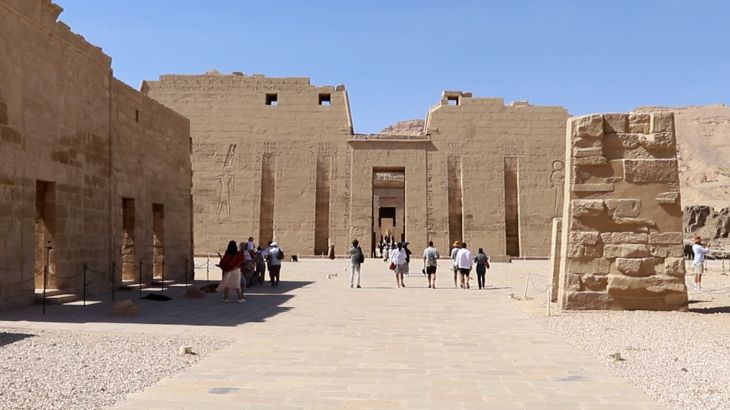
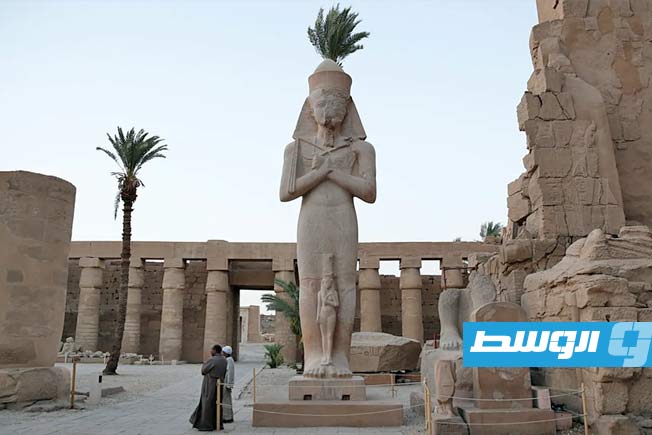
By boats crossing the Nile River to the western side in Luxor Governorate, southern Egypt, or via a modern bridge spanning the river, one can reach the “Medinet Habu” temple, which appears as a majestic structure with massive walls, columns, and statues. It is one of the most important Pharaohs’ temples, built approximately 3,000 years ago.
The road leading to the historic temple, situated among famous Pharaonic monuments and tombs, seems like guardians accompanying visitors to it.
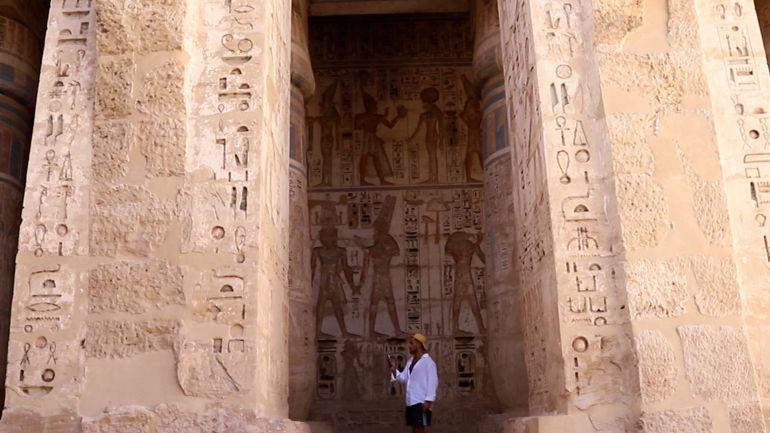
At the end of the road, the temple appears with its awe-inspiring walls that have preserved their historical inscriptions and vibrant colors despite the passage of thousands of years.
The Temple’s History and Its Religious and Architectural Significance
The name “Habu” has two meanings, the first being “the fortified place,” and the other is “the feast and religious rituals” associated with that funerary temple connected to the journey of eternity and the afterlife.
Some suggest that the word “Habu” refers to Amenhotep, son of Hapu, the vizier of Pharaoh Amenhotep III, while others believe this name goes back to the father or priest who resided in this area afterwards.
All that the Pharaohs established on the West Bank, including tombs and temples such as “Medinet Habu,” has a funerary and religious character.
According to information, the famous Pharaoh Ramesses III (circa 1184 – 1153 BC), the most renowned king of the 20th Dynasty, is the one who built the “Medinet Habu” temple, dedicated to performing funerary rituals and rites for the worship of the god Amun.
The temple is surrounded by a massive wall built with two guard rooms, and it is centered by a great eastern gate with two towers featuring balconies.
The eastern gate leads to the first pylon of the temple, then to a courtyard, followed by the second pylon and another courtyard, then three columned halls and a group of chapels, then the sanctuary (the place of worship), and behind it a group of rooms.
The Pharaonic temple also includes remains of the royal palace, storerooms, and buildings for temple administration.
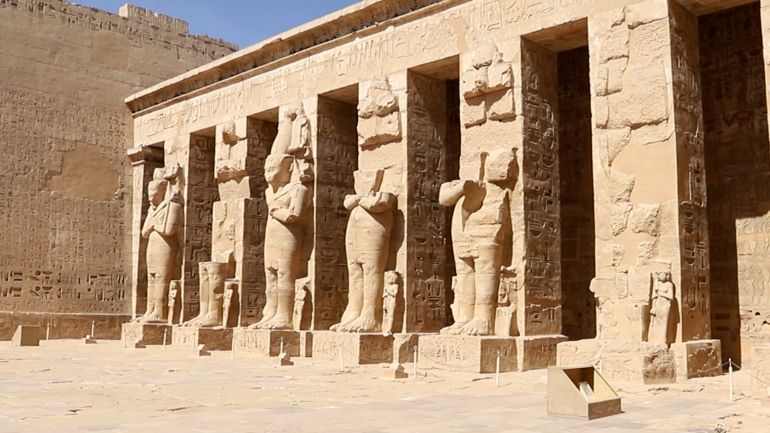
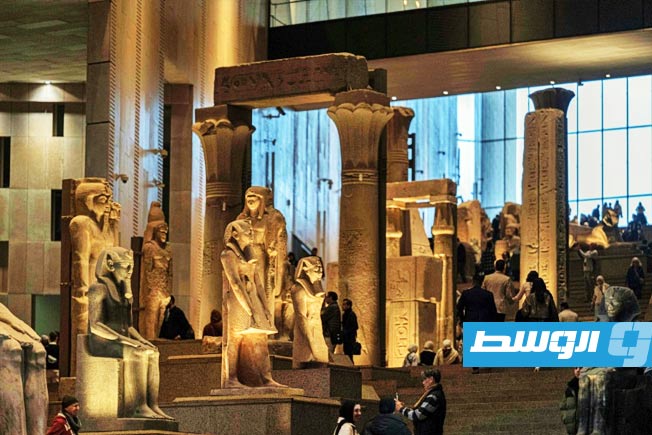
The temple contains many columns, some round with capitals, and others representing Pharaoh Ramesses III.
The temple is located on the West Bank in Luxor Governorate, home to Egypt’s most famous tourist attractions such as the Valley of the Kings.
The Temple and Its Touristic and Archaeological Importance
The area surrounding the temple includes another temple built by Queen Hatshepsut and King Thutmose III on the site of a temple established in the 12th Dynasty. It also includes the “Tombs of the Divine Adoratrices of Amun-Ra” dating back to the 25th and 26th Dynasties.
Previously, there was a canal connecting the temple to the Nile River, allowing access by boat.
The area surrounding the temple was used to protect the inhabitants from attacks from the west, as well as to protect the temple during periods of war in the reign of Ramesses III.
The temple’s decorations depict Pharaoh Ramesses III in military scenes such as campaigns and battles, as well as hunting scenes and exploratory expeditions.
Religious scenes are also shown, such as the king worshiping, alongside many scenes of various celebrations.
The temple is considered an “architectural masterpiece” due to its amazing decorations and inscriptions, and it is one
Nile River
The Nile River is a major north-flowing river in northeastern Africa, historically considered the longest river in the world. It has been the lifeline of civilization for millennia, most famously supporting the rise of ancient Egyptian culture and agriculture through its annual flooding and fertile silt deposits.
Luxor Governorate
Luxor Governorate in southern Egypt is built upon and around the ancient city of Thebes, the powerful capital of the New Kingdom. It is renowned for its monumental archaeological sites, including the Karnak and Luxor Temples on the east bank and the Valley of the Kings and Queens on the west bank.
Egypt
Egypt is home to one of the world’s oldest civilizations, with a recorded history spanning over 5,000 years and iconic monuments like the Pyramids of Giza and the Sphinx from the Old Kingdom era. Its rich cultural legacy includes pharaonic, Greco-Roman, Coptic Christian, and Islamic influences, with the Nile River serving as the central artery for its development and sustenance.
Medinet Habu
Medinet Habu is a mortuary temple complex located on the West Bank of Luxor, Egypt, primarily built by Pharaoh Ramesses III of the 20th Dynasty. It served as both a temple dedicated to the god Amun and a memorial to the pharaoh’s reign, with its walls recording his military victories, including against the Sea Peoples. The site, which also includes earlier structures and later became an important Coptic Christian town, is one of the best-preserved temples in Egypt.
West Bank
The West Bank is a landlocked territory in the Middle East, located west of the Jordan River, with a central history tied to ancient biblical kingdoms. It came under Jordanian rule after the 1948 Arab-Israeli War and was captured by Israel in the 1967 Six-Day War, leading to ongoing Israeli settlements and Palestinian claims for statehood. Today, its status remains a core issue in the Israeli-Palestinian conflict.
Valley of the Kings
The Valley of the Kings is a burial site on the west bank of the Nile in Egypt, used as a royal necropolis for pharaohs and powerful nobles during the New Kingdom period (circa 16th to 11th century BCE). It is most famous for the tomb of Tutankhamun, discovered nearly intact in 1922, and contains over 60 elaborate tombs carved deep into the limestone rock.
Queen Hatshepsut
Queen Hatshepsut was a female pharaoh of ancient Egypt who ruled during the 18th Dynasty (c. 1479–1458 BCE). Her most famous monument is the Mortuary Temple of Hatshepsut at Deir el-Bahari, a grand, terraced structure built into the cliffs near Thebes. She is remembered for a prosperous reign marked by ambitious building projects and a major trading expedition to the land of Punt.
King Thutmose III
King Thutmose III was the sixth pharaoh of Egypt’s 18th Dynasty, reigning in the 15th century BCE and often called the “Napoleon of Egypt” for his extensive military campaigns that expanded the Egyptian Empire to its greatest size. His legacy is prominently preserved at the Temple of Karnak in Luxor, where he erected obelisks and recorded his victories in detailed annals on the temple walls.
Tombs of the Divine Adoratrices of Amun-Ra
The Tombs of the Divine Adoratrices of Amun-Ra are a group of burial sites at Medinet Habu in Luxor, Egypt, dating to the Third Intermediate and Late Periods. These tombs were constructed for the high priestesses, who were often royal princesses, holding immense religious and political power as the human consorts of the god Amun-Ra. Their elaborate subterranean tombs feature intricate reliefs and texts, reflecting their significant role in the Theban theocracy of the era.