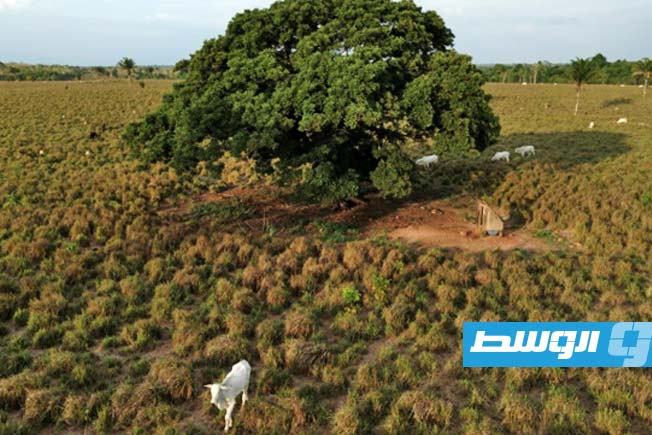
Aerial photo of cattle on the outskirts of Mai do Rio, in the state of Pará, in the Brazilian Amazon, on December 11, 2024.
Australia’s forests are losing trees at an accelerating rate as climate warming worsens, according to a study published Tuesday in the journal “Nature Plants,” which relied on data collected over decades.
The study was based on forest inventory data from 2,700 plots of land across the country, within four different ecosystems: tropical savanna, cool temperate forests, warm temperate forests, and humid tropical forests.
“We found that the tree mortality rate has steadily increased over time, in all forest types,” said the lead researcher.
It was explained that “it is very likely that this increase is due to rising temperatures.”
Areas affected by logging, deforestation, or fires were excluded from the study, which aimed to examine the evolution of the “natural tree mortality rate” over the past few decades.
–
–
The study noted that the highest increase in tree mortality was recorded in tropical savannas, rising by 3.2% annually, from about 15 per thousand trees in 1996 to approximately double that in 2017.
Decline in Forest Stock
The study showed that tree death was not compensated by growth, leading to an overall decline in forest stock.
“It is very likely that the overall capacity of forests to store carbon will decrease over time,” the researcher stated.
A study published a few months earlier showed that Australia’s humid tropical forests are among the world’s largest sources of carbon dioxide emissions compared to what they absorb.