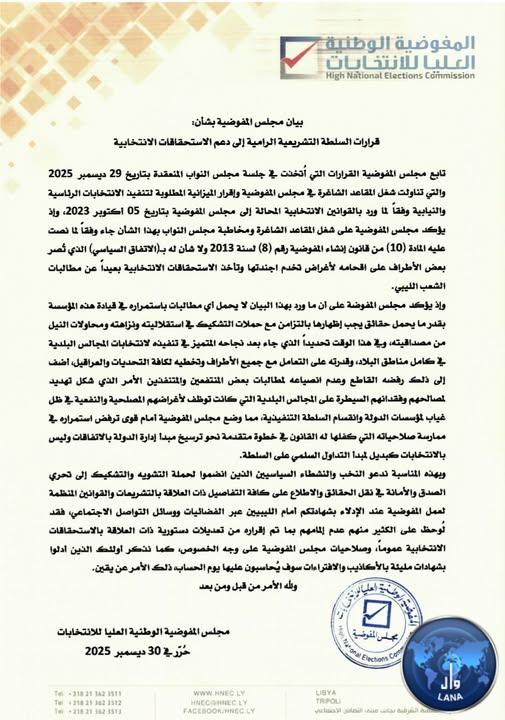
Tripoli, December 30, 2025 – The High National Elections Commission (HNEC) Council confirmed that filling the vacant seats and addressing the House of Representatives on the matter was carried out in accordance with Article 10 of the law establishing the Commission. It stated that this has no connection to the “political agreement” which some parties insist on invoking for purposes that serve their own agendas and divert electoral processes away from the demands of the Libyan people.
This came in a statement from the Commission’s Council following the decisions made by the House of Representatives in its session yesterday, Monday. Those decisions addressed filling the vacant seats on the Commission’s Council and approving the required budget to implement presidential and parliamentary elections, as stipulated in the electoral laws referred to the Commission on October 5, 2023.
The Council affirmed that this statement does not carry any demands for its continued leadership of this institution, but rather presents facts that must be revealed concurrently with campaigns casting doubt on its independence, integrity, and attempts to undermine its credibility. It pointed out that the statement comes after its distinguished success in implementing municipal council elections across all regions of the country, its ability to deal with all parties and overcome all challenges and obstacles, and its firm refusal and non-compliance with the demands of certain beneficiaries and influential figures. This refusal threatened their interests and caused them to lose control over municipal councils, which had been utilized for their own opportunistic and utilitarian purposes amid the absence of state institutions and the division of the executive authority. This has placed the Commission’s Council in confrontation with forces that reject its continued exercise of the powers guaranteed to it by law, in an advanced step towards entrenching the principle of state management through agreements rather than elections, as an alternative to the principle of peaceful transfer of power.
In its statement, the Commission’s Council called on the elites and political activists who have joined the smear and doubt campaign to be truthful and honest in conveying facts and to review all details related to the legislation and laws regulating the Commission’s work before giving their testimony to the Libyan people via satellite channels and social media.
The Council noted that it has been observed that many of them are not aware of the approved constitutional amendments related to electoral processes in general, and the powers of the Commission’s Council in particular. It reminded those who have given testimonies full of lies and slander that they will be held accountable on the Day of Judgment, a matter stated with certainty according to the text of the statement.