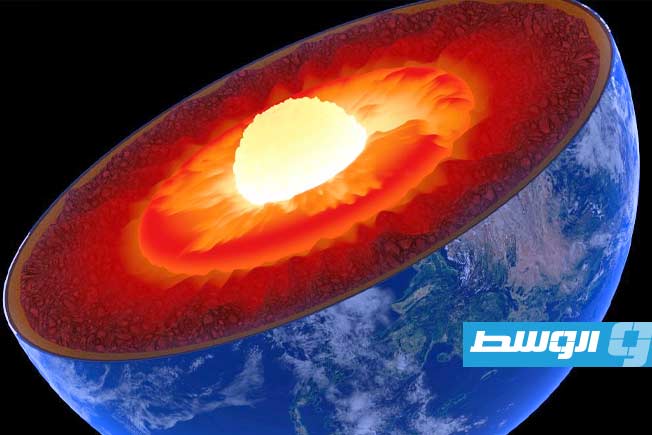
A team of scientists has proven, by launching projectiles made of iron-carbon alloys at immense speeds, the existence of a strange state of matter that combines both ‘solidity and fluidity’ simultaneously. This explains why Earth’s inner core is ‘butter-soft’ rather than cold steel, as had been believed since the 1930s.
The research team used a technique known as ‘dynamic shock compression’. Using advanced gas guns, samples were launched at speeds exceeding 7 kilometers per second towards lithium fluoride targets, generating immense pressure reaching 140 gigapascals and temperatures nearing 2600 Kelvin, according to the study.
Although these conditions lasted for mere fractions of a billionth of a second, they were sufficient to use lasers and precise sensors to prove that the iron-carbon alloy enters a ‘superionic state’ under such pressures.
‘Batman’ and ‘Robin’
It was explained that this state resolves long-standing discrepancies in seismic data: “In this state, carbon atoms become highly mobile, diffusing through the iron crystal lattice like children running around a dance floor, while the iron itself remains solid and orderly.”
This strange harmony was further described: “The iron network remains fixed in place like the character Batman, while carbon flows through the gaps like an impulsive Robin. This superionic phase significantly reduces the alloy’s stiffness, explaining why sound waves slow down when passing through Earth’s center.”
Measurements have puzzled scientists for decades, suggesting the inner core is ‘spongy’ or ‘soft’ in a way inconsistent with it being entirely solid iron.
The importance of this discovery extends to understanding how Earth’s magnetic field is generated.
It was stated: “We are now moving from a static, solid inner core model to a dynamic, interactive one.” Adding, “Understanding this hidden state of matter brings us one step closer to uncovering the secrets of other Earth-like planets.”
Earth
Earth is the third planet from the Sun and the only known astronomical object to harbor life, with its history spanning approximately 4.54 billion years. Its geological and biological evolution, from the formation of the first oceans to the development of complex ecosystems, has created the unique environment that sustains humanity and all known species.
Earth’s inner core
Earth’s inner core is a solid metallic sphere, primarily composed of iron and nickel, located at the planet’s center beneath the liquid outer core. It is believed to have formed approximately 1 to 1.5 billion years ago through the gradual cooling and crystallization of molten iron within Earth’s interior.
Earth’s center
Earth’s center, or the Earth’s core, is the innermost part of our planet, composed primarily of iron and nickel. It is divided into a solid inner core and a liquid outer core, whose motion generates Earth’s magnetic field. While not a physical site to visit, its existence and properties have been inferred through scientific study, particularly seismology, over the last century.
Earth’s magnetic field
Earth’s magnetic field is a natural, dynamic force surrounding our planet, generated by the movement of molten iron in its outer core. It has existed for billions of years, though it periodically weakens and reverses polarity over vast geological timescales. This field is crucial for life, as it deflects harmful solar radiation and guides navigation for many species.
Mars
Mars is the fourth planet from the Sun and is often called the “Red Planet” due to its iron oxide-rich surface. It has been a subject of human fascination and scientific study for centuries, with modern exploration beginning with spacecraft flybys in the 1960s. The planet’s history includes evidence of ancient river valleys and lakes, suggesting it once had conditions potentially suitable for life.
South Atlantic Anomaly
The South Atlantic Anomaly is a region over the South Atlantic Ocean where Earth’s inner Van Allen radiation belt comes closest to the planet’s surface, creating an increased flux of energetic particles. This phenomenon is caused by a significant deviation in Earth’s magnetic field, attributed to the tilt and offset of the planet’s magnetic dipole.