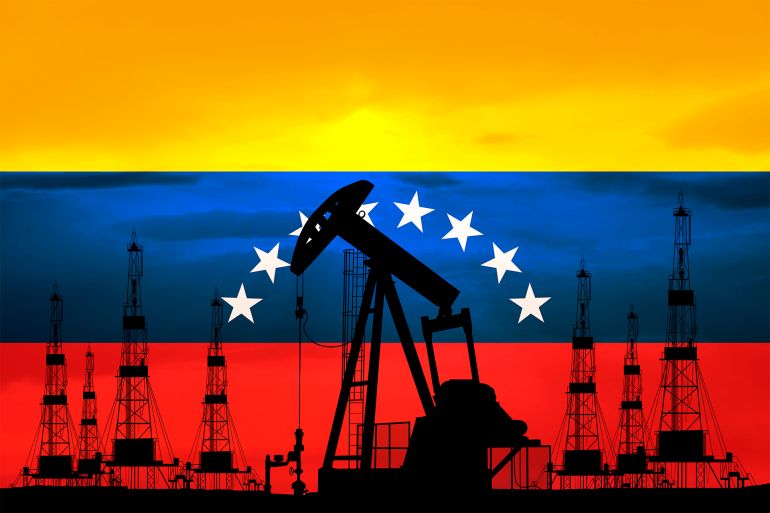
Moscow– The US President’s announcement of a comprehensive blockade on all authorized oil tankers entering or leaving Venezuela is an event of not only regional but global significance.
Although the US decision will make purchasing Venezuelan oil through unofficial channels more difficult for Europeans; and considering that most Venezuelan oil is currently exported to , Russian observers confirm that the US Navy will try by all means to intercept Venezuelan oil tankers, hoping to strangle its economy with a naval blockade.
In parallel, they confirm that the US decision is closely linked to the Russian-Ukrainian crisis and will have varying repercussions on the Russian economy. Furthermore, the decision could lead to Venezuela’s complete isolation, destabilization, and the deprivation of of a key strategic partner in Latin America.
At a Critical Time
The decision came about one month after the Venezuelan parliament approved the extension of joint oil projects with Russia until 2041; aiming to strengthen the strategic energy alliance between the two countries under current international sanctions.
The mentioned agreement stipulated the completion of joint projects between the two countries for a period of 15 years (from 2026 to 2041), which included – among other things – the development of two major fields in the western region of Venezuela, namely “Boceron” and “Petroperija”. During this period, approximately 91 million barrels of oil are scheduled to be produced, with a total investment estimated at around $616 million.
How Does the Naval Blockade on Venezuela Affect Russian Interests?
A researcher at the Higher School of Economics believes that imposing a blockade on Venezuela has economic and trade repercussions and risks, and deals a strong blow to Russian oil companies.
He explains that the naval blockade on oil tankers complicates logistics for Russian companies like “Rosneft” and “Lukoil”, which are already suffering from US sanctions pressure.
In his view, imposing a 25% tariff on goods coming from countries importing Venezuelan oil also creates additional financial obstacles for international cooperation in which Russia participates.
He also states that the blockade decision led to a sharp rise in energy prices. However, he points out that while rising prices benefit the Russian budget, market instability and the threat of secondary sanctions on buyers of Russian oil (like China) may reduce this effect.
Will US Sanctions Cause a Freeze on Projects Between Moscow and Caracas?
According to the analyst, the US sanctions imposed on Venezuela, which were significantly tightened by the end of this year, pose serious obstacles to joint projects between Moscow and Caracas, but a complete freeze is unlikely; given that both sides have adapted to the sanctions regime.
He adds that despite the pressures, and Caracas continue to strengthen their bilateral relations, considering that the recent sanctions on Caracas serve as an incentive to explore alternative mechanisms for cooperation outside the US financial system.
Nevertheless, the speaker suggests that joint projects between Russia and Venezuela will in any case become more costly and risky, necessitating the use of complex methods to circumvent them; in order to maintain strategic cooperation between the two countries.
Does Freezing the Accounts of the Venezuelan Oil Company and Restrictions on Bond Transactions Pose an Obstacle to Repaying Russian Loans?
According to an economic expert, freezing billions of dollars in assets of the government and the Venezuelan oil company deprives Caracas of access to foreign exchange earnings from oil exports to the United States, which is the main source of liquidity needed to service its external debts, including those to Russia.
Furthermore, sanctions and restrictions on intermediaries from financial institutions, including Russian banks like “Evrofinance” bank – which helps the Venezuelan oil company circumvent sanctions – make it practically difficult to transfer funds from Venezuela to Russia.
In addition, restrictions on trading Venezuelan bonds in the secondary market reduce their liquidity, preventing Russia from using these securities as
Moscow
Moscow is the capital and largest city of Russia, with a recorded history dating back over 800 years to its first mention in 1147. It grew from a medieval fortress, the Kremlin, to become the political and cultural heart of the Russian state, serving as the capital of the Tsardom of Russia, the Soviet Union, and the modern Russian Federation.
Venezuela
Venezuela is a South American country with a history of indigenous inhabitation before Spanish colonization in the 16th century, leading to its independence in 1811 under Simón Bolívar. It is known for its significant natural resources, primarily oil, and diverse landscapes ranging from the Andes Mountains to the Amazon basin and Angel Falls, the world’s highest waterfall.
Boceron
Boceron is a traditional neighborhood in Lima, Peru, known for its historic bullring, the Plaza de Acho, which dates back to 1766. The area is culturally significant for its deep ties to Peruvian bullfighting, criollo music, and gastronomy, representing an important part of Lima’s popular heritage.
Petroperija
Petroperú is a state-owned oil company in Peru, founded in 1969 to manage the country’s hydrocarbon resources. It operates the Talara Refinery, one of the oldest in South America, and plays a central role in Peru’s energy sector and industrial history.
Rosneft
Rosneft is a major Russian state-controlled oil and gas company, founded in 1993 from assets previously managed by the Soviet Ministry of Oil and Gas. It grew significantly through acquisitions, most notably of TNK-BP in 2013, to become one of the world’s largest publicly traded petroleum companies.
Lukoil
Lukoil is a major Russian multinational energy corporation headquartered in Moscow, specializing in the exploration, production, and sale of petroleum, natural gas, and petroleum products. It was founded in 1991 following the dissolution of the Soviet Union, emerging from the state-owned oil and gas assets of the former Ministry of the Oil and Gas Industry.
China
China is one of the world’s oldest continuous civilizations, with a recorded history spanning over four millennia. It is home to numerous UNESCO World Heritage sites, such as the Great Wall and the Forbidden City, which reflect its long imperial past and profound cultural achievements.
Caracas
Caracas is the capital and largest city of Venezuela, founded in 1567 by Spanish conquistador Diego de Losada. It grew as a colonial administrative center and later became the birthplace of Simón Bolívar, a key figure in South America’s independence movements. Today, it is a major metropolitan and cultural hub situated in a valley of the Venezuelan coastal mountain range.
Evrofinance
Evrofinance is a Russian commercial bank founded in 1990, originally known as Eurofinance Mosnarbank. It was established as a joint venture between Russian entities and the French bank BNP Paribas, with a notable historical connection as it was used for financial operations by Venezuela’s state oil company, PDVSA. The bank has faced international scrutiny, including U.S. sanctions in 2019 due to its role in facilitating Venezuelan transactions.
United States
The United States is a federal republic founded in 1776 following its declaration of independence from Great Britain, establishing itself through a revolutionary war and the ratification of a constitution that created a representative democracy. Its history is marked by westward expansion, industrial growth, waves of immigration, and significant domestic and international conflicts that shaped its role as a global power.
Latin America
Latin America is a vast region encompassing the parts of the Americas where Romance languages—primarily Spanish and Portuguese—are spoken, sharing a complex history shaped by indigenous civilizations, European colonization, and subsequent waves of independence. Its cultural sites, such as Machu Picchu in Peru or the historic centers of Mexico City and Quito, reflect this layered heritage, from pre-Columbian empires to colonial architecture and modern influences.
Ukraine
Ukraine is a country in Eastern Europe with a rich history dating back to the medieval state of Kyivan Rus. It has experienced periods of independence as well as rule by various empires, before re-establishing its sovereignty with the dissolution of the Soviet Union in 1991. The country is known for its diverse cultural heritage, Orthodox Christian cathedrals, and the Black Sea coastline.
Higher School of Economics
The Higher School of Economics (HSE University) is a major public research university in Russia, founded in 1992 to advance economics and social sciences education following the Soviet Union’s dissolution. It has rapidly grown into a prestigious institution with multiple campuses, known for its strong focus on modern economics, sociology, political science, and data science.
US Navy
The United States Navy was established in 1775 during the American Revolutionary War and is a branch of the U.S. Armed Forces responsible for naval warfare. It has grown into the world’s largest and most capable navy, playing a decisive role in securing American interests and global maritime security throughout history.